Voices behind the screen

For Molly Ryan (MLitt 2022), coming to St Andrews for a postgraduate degree marked a change of direction from museums and heritage into a career in film. She reflects on student life the year the world returned to ‘normal’ and shares her experience as a programmer at the Sands International Film Festival, which celebrates its fifth edition this April.
I came to St Andrews in 2021 for the MLitt in Film Studies, and that was a moment to pivot, career-wise, for me, and to open up the possibilities for my future. I had graduated from Harvard with an undergraduate degree in History and Literature and had worked for six years in an art museum. What I enjoyed most about my first degree was that it was a very interdisciplinary academic approach, and I was excited about the ways that carried over into my work working in public programmes. The role was an interesting combination of things I was good at like planning events, brainstorming creative ideas, and bringing people together. I liked the educational rigour of the museum work, learning about art and connecting artists and audiences across time periods and geographic boundaries.
When I started working, I was fortunate to secure a role in a museum that was well established but had been closed for eight years, so it felt like a bit of a start-up mentality. We had to figure out how to use a brand new, beautiful building that had all these purpose-built spaces for public engagement activities to share the museum’s collections in exciting ways. It was a really cool opportunity as a new grad.
I got to dive right in and play a critical role in shaping a vision for public programmes, but what was one of the most fortunate opportunities was that there was a new space fitted out for cinema. There was no clear plan of how it was going to be activated or programmed, and that part of my job that I got really excited about. I was continuously drawn to this opportunity to think about how film could intersect with the museum’s collection and how it could activate and convene conversations about the broader world through the immersive experience of watching together. I had always loved film, but this opportunity helped me realise I could potentially do more with that passion.
A change of direction
Once I had been in my role for six years, I reached a point where I needed to think about a next step, and it was the disruption of the pandemic that really pushed me to consider what I wanted to do next. I decided to apply for a Masters programme in Film Studies and had always been interested in living abroad, having grown up in Boston in the US, so I focused on institutions in the UK and Europe.
As I was exploring possibilities, I was particularly drawn to the faculty and the opportunities at St Andrews. I was also excited about the vibrancy of the Scottish film industry and how much was happening on the production side. I knew the Masters programme would only be for one year so I wanted a place where I could get to know people and feel connected to the community. I also wanted to study hard and learn as much as I could in that short time. The Department of Film Studies at St Andrews offered me all of that.
The Sands International Film Festival was in the planning stages at the time, having been delayed by the pandemic. That was the tipping point for me when choosing St Andrews and in some ways, I had the very good fortune of being in the right place at the right time to be among the first to steward this opportunity.
I didn’t know exactly how I would be able to get involved when I arrived in St Andrews but felt excited at the possibility that I could have access to a new pre-professional pathway in the film industry. I wanted to explore that.
Creating a community
Luckily, it all came together. Our first semester at St Andrews was like a re-emergence into the world after Covid. We were still wearing masks and when I booked my flight over to Scotland, quarantine protocol was still in place. I was expecting to have to be isolated in a room for two weeks on arrival. The quarantine requirements were removed just before I travelled, but it was reassuring that St Andrews was clearly prepared for welcoming students back safely in an in-person way.
After so many months of feeling anxious, my classmates and I felt all the more joyous to be together. We quickly became very committed to going to see movies together at the New Picture House, going for walks on the beach, grabbing coffee. St Andrews just lends itself to being out and about together and meeting people. I feel really lucky to have arrived at that moment.
In that first semester we started talking about our modules for the spring and there was an opportunity to apply to be part of the programming team at what would be the first Sands festival.
I couldn’t wait to apply and was thrilled to be selected. There were seven of us in total, spanning the undergraduate programme, three MLitt students, and two PhD students. We became a tight group.
The festival: first edition
The Festival Director, Ania Trzebiatowska, selected a series of feature films – all directorial debuts – for us to evaluate as a team. We would watch each film, make notes, ask questions, jot down our gut reactions, before meeting to talk about them. The goal was to curate a diverse and inclusive programme for the festival. What was really wonderful was that it wasn’t so much our individual opinion that mattered. It was the collective view of the team involved.

Ania managed the experience really well from an educational perspective. She was a wonderful person for me to meet at that point in my education and career. The film industry has a reputation for being cut-throat and competitive, but Ania is the opposite of that. She brings joy, kindness and community spirit to all that she does. It was really impactful to have a role model like that.
We would debate our favourite films and which we thought would resonate with the audience of the Sands International Film Festival, which was a hard question because it was the first one. What is fun about programming – and about movies in general – is that people don’t always agree or respond to films in the same way. We often feel strongly about what we like, or don’t. One of the films we universally agreed was fantastic was a documentary called Long Live My Happy Head, which is about a Glasgow-based artist who has been diagnosed with terminal brain cancer and was coping with that diagnosis while still making art in the world. We all loved that film.

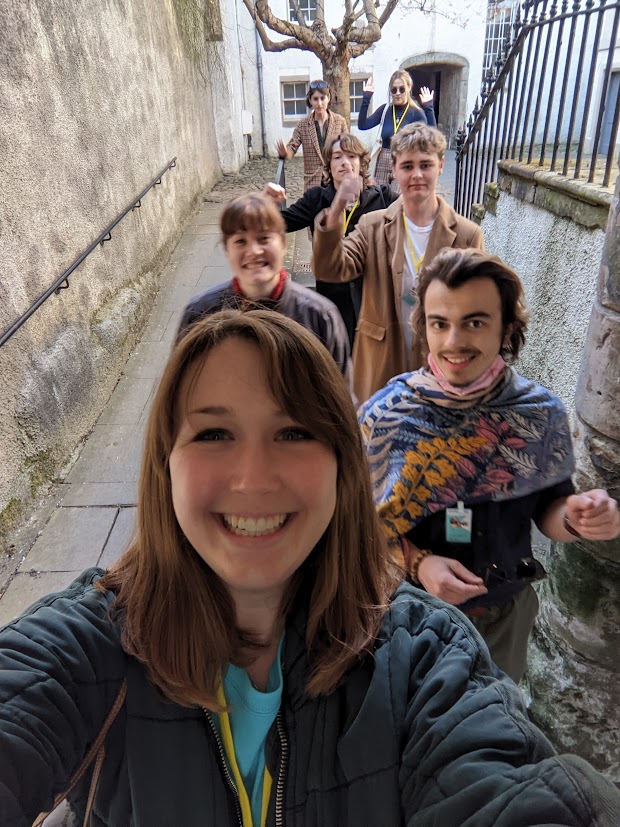
When the festival came around, we all felt a real sense of ownership for the programme and went on to volunteer over the weekend, managing the guest table, taking photos for social media, helping guests to get to where they needed to be, watching all the films again.

We had all, somewhat naturally, aligned ourselves with certain films on the programme during the curatorial process, and the film I’d become champion of was Hive, directed by Blerta Basholli. It was a really difficult film about the trauma of war, but also an incredibly beautiful and powerful story of resilience. The filmmaker wasn’t able to attend in person, but I got the chance to interview her online, which was recorded and played to the audience after the screening. It was so cool to engage a filmmaker in meaningful questions about their work, and it felt remarkable that we were empowered to do that as students. To be entrusted to do that as a student and to steward that relationship is really special.
While at St Andrews, I also worked on the student-run arts festival, On the Rocks, for which we did a crossover event with Sands. It was a screening of FATHOM, which centred on Dr Michelle Fournet and Dr Ellen Garland’s research on whale communication. Dr Garland is a Reader in the School of Biology at St Andrews. This film screening would later come up in my job interview at Cornell University as Dr Fournet was a researcher in their Center for Conservation Bioacoustics.
A career at Cornell
Towards the end of my MLitt, I was thinking about the direction in which I wanted to go in the film industry. I considered moving to London or LA and trying to become a producer. I considered a PhD. But I had really enjoyed being part of Sands and was interested in continuing in public engagement work at an institution or a festival. Somewhere I could do something similar to my previous career, but with a focus on film and filmmakers.
An opportunity arose at Cornell University in Ithaca, New York, to be Director of Cornell Cinema, which is the university’s on-campus film exhibition programme. Cornell Cinema is a single-screen cinema in an historic space that presents an eclectic mix of contemporary and classic from around the world. I applied while still at St Andrews and wasn’t sure what would come of it, but as it happened, I had the right combination of experience for the role.
I have been the director of Cornell Cinema for about three years now and I draw upon all I learned through Sands and at St Andrews in my programming work each day. It was intimidating at first being solely responsible for the creative direction of an entire organisation, but it is thrilling to have a platform to champion films I believe in and introduce new generations of students to the history of film. In a polarised world, the work of gathering people together for shared experiences that expand our imaginations feels more important than more. If I’m ever on the fence about a film or a programming decision, I have this inspiring community of people from St Andrews that I can reach out to for advice. That’s one of the greatest joys of having chosen St Andrews.
Sands: International Film Festival of St Andrews is made possible thanks to the generous support of donors and partners.
Find out more about supporting St Andrews through the Making Waves Campaign.