World Bee Day: beyond the hive

To mark World Bee Day 2024, alumnus Gavin Ballantyne (PhD 2011) reflects on the importance of appreciating pollinators and all that they do for us. He also highlights the many species that are so often overlooked and could be at risk as the result of a biodiversity crisis.
World Bee Day – on 20 May – is a brilliant opportunity to better appreciate pollinators and all that they do for us. Many people have some understanding of their importance; however, the media and corporate coverage usually only tells a small part of the story.
The pros and cons of honeybees
Beekeeping is fantastic for providing pollination services for some of our crops and wild plants. It also gives us honey and can engage young people through hands-on experiences with bees. These benefits are especially vital in developing countries, such as Ethiopia, where beekeeping is hugely important on a cultural level and can provide win-win opportunities for pollination services and economic development.
But that focus on honey and beekeeping revolves around a single species, the honeybee, which in many parts of the world is a domestic insect. It doesn’t tell us much about the rich lives of the hundreds of other bee species in UK and thousands around the world.
There’s a clear consensus among scientists and beekeepers that high densities of beehives can be harmful, not just for the honeybees themselves, but also for wild bee species that are outcompeted by the more abundant and usually less fussy honeybees and can catch diseases from them. While responsible beekeepers will only keep a limited number of hives, corporate greenwashing initiatives like those to put a honeybee hive on every roof will only contribute to the biodiversity crisis.
Bees in all shapes and sizes
Wild bees come in all shapes and sizes, from different species of bumblebees to the huge number of solitary bee species. These solitary individuals range from species that look like honeybees – like mining bees or mason bees – to the tiny and often overlooked sweat bees. They’re solitary because, instead of living in a colony, an individual female bee will establish her own nest (in a soil bank or hollow space) and provision it with nectar and pollen to feed her offspring. While some of these species are thriving, many more are struggling, especially specialists with particular food and nesting requirements.
The climate crisis
As well as the more commonly discussed threats of habitat loss and pesticide use, climate change is influencing our bee communities in a variety of ways. With our recent milder winters in Scotland, we’re seeing an increasing number of new arrivals, from the successful tree bumblebee to the adorable hairy-footed flower bee. But the increasing frequency and severity of extreme weather events caused by climate change is putting extra pressure on bees. Recent studies have shown that baby bumblebees and mason bees are much more likely to die in heatwaves. So, while the adult bees might be coping with the heat above ground, in their nests the next generation has been wiped out.
Beyond bees
Of course, it’s not just the bees we need to look out for. There’s a whole world of non-bee species that pollinate our crops and wild plants. Hoverflies can be fantastic pollinators, from harmless wasp mimics to furry honeybee and bumblebee mimics, and they don’t get nearly enough attention. While it may not be what some people want to hear, there’s also more than enough evidence to show that wasps can also be great pollinators. If that wasn’t enough, wasps and many hoverflies also provide important pest control services by eating other bugs.
The diversity of life
When you think about it, only valuing species that directly benefit us is no way to live. So, this World Bee Day, let’s take things a step further and celebrate the parasites of bees! These include the cuckoo bumblebees, nomad bees and bee flies, that lay their eggs in the nests of bees (flinging their eggs right into the nest entrances, in the case of bee flies!) to take over and steal the floral resources that have been collected. These fascinating, often beautiful, species contribute to our understanding of evolution and ecology and add to the weird and wonderful diversity of life.
In the battle against habitat loss, neat tidy lawns, unnecessary pesticide use and artificial grass, don’t just think of the honeybees, think of the solitary bees, hoverflies, and parasites too.
Words by alumnus Gavin Ballantyne (PhD, 2011), an ecologist interested in pollination and whose research focuses on studying the interactions between different species and flowering plants.
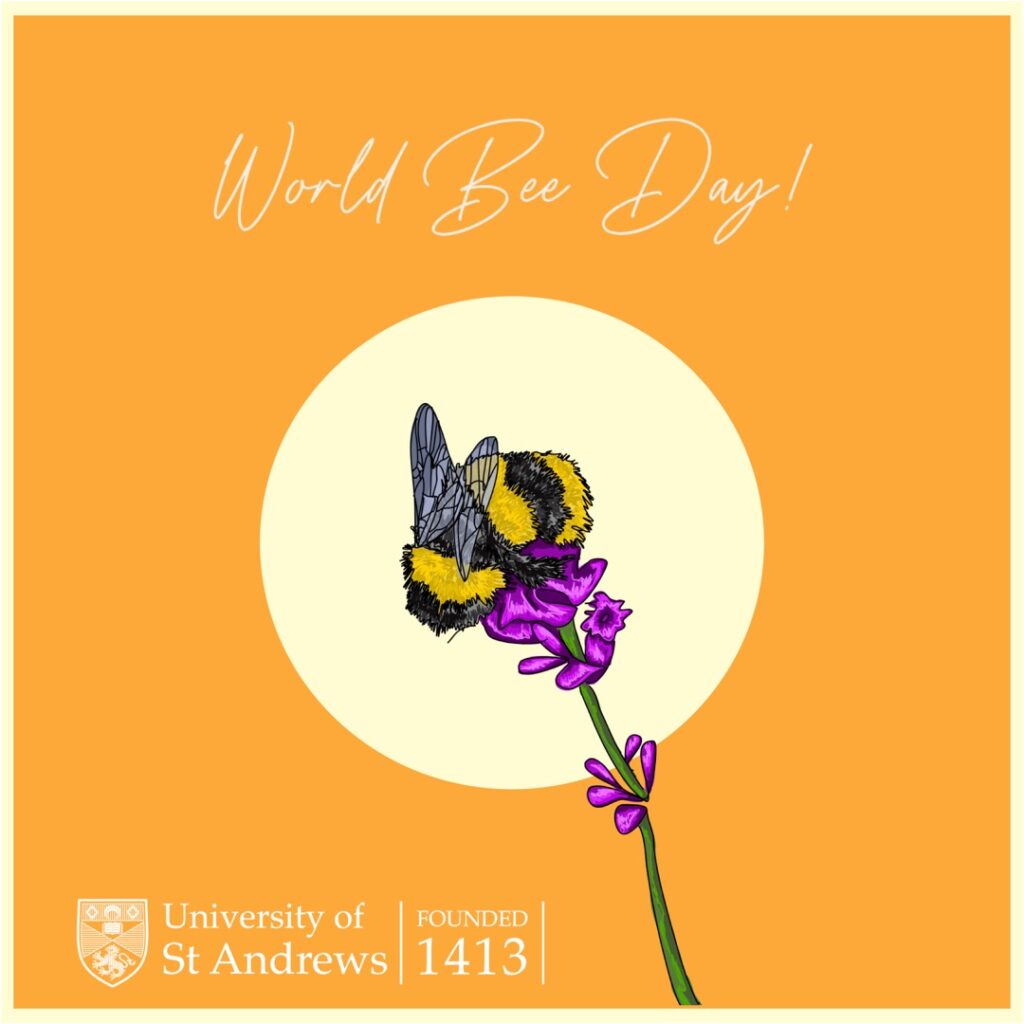
Image by Amrita Rahman
Find out more about the information in this article, pollinators and their importance using the following links:
If you want to explore the diversity of flower-visiting insects and other invertebrates in more depth, visit Buglife’s bug directory: https://www.buglife.org.uk/bugs/bug-directory/
For an introduction to bumblebees in the UK visit: https://www.bumblebeeconservation.org/learn-about-bumblebees/species-guide/
For an introduction to solitary bees in the UK visit: https://www.wildlifetrusts.org/blog/ryan-clark/identify-solitary-bees-uk#:~:text=In%20Britain%20we%20have%20around,like%20bumblebees%20and%20honey%20bees.
More on the heatwave risk to bees visit: https://www.newscientist.com/article/2429636-rising-temperatures-are-cooking-bumblebee-nests-and-killing-larvae/#:~:text=When%20nest%20temperatures%20surpassed%2036,kill%20a%20nest’s%20next%20generation.
If you’d like to understand the lives of bees in more depth, I recommend Lars Chittka’s excellent book, The Mind of a Bee: https://twitter.com/LChittka