From student to storyteller

Lucy Ribchester (MA Hons 2004) chose St Andrews over Edinburgh and English over Law. She shares her story of student days, firm friendships, Shakespeare studies and pursuing a creative career in writing.
It was while doing work experience in a lawyer’s office that I made the decision to study English at university. At the time the TV show Ally McBeal had just premiered, and I decided that writing lurid and improbable plotlines about lawyers looked like a lot more fun than being one.
I have always loved books, plays, films and writing. As I progressed through the English curriculum at school, I loved the opportunities to dive deeper into the texts we were studying and probe the literary techniques to see how they illuminated the ideas.
St Andrews: love at first sight
I had initially set my sights on studying at the University of Edinburgh, but during sixth year one of our English teachers took us on a school trip to see Seamus Heaney read from his new edition of Beowulf at the Buchanan Lecture Theatre in St Andrews. I was won over by the small, cosy feel of the town, its atmosphere, historic buildings, ruined clifftop castle, and compact lanes.
I went to a state school in Fife, where I had become used to having to downplay my academic inclinations to avoid being bullied, and it was an adjustment to get used to the confidence a lot of my fellow St Andrews students wore easily. I didn’t find it easy speaking up in tutorials at the start. I would become tongue-tied and worry my ideas were trite. After I handed in my first essay my tutor asked me why my essay was much better than my oral contributions in class. With some encouragement I gained the confidence to speak up a bit more. This grew during my time at St Andrews, and I ended up graduating with the class medal and the Samuel Rutherford Prize.
Friends for life
I formed great friendships in first year with a group of students I lived with in McIntosh Hall. We were all studying different subjects but bonded over silliness and drunken games, Chattan Assassin tournaments (a water pistol-based, ‘pick-‘em-off’ game that was a McIntosh institution), and making Napster playlists. I still have my raisin string (a bumblebee keyring) given to me by my academic mother, and I have kept in touch with my academic sister.
In my second year, I lived on North Street in a house with two other UK students and Becca, a Junior Year Abroad student from the US. One day Becca brought home her tutorial buddy, Caraigh, who was also a colleague at Northpoint Café where she worked. I had noticed Caraigh walking about town with a very fetching brown satchel, and I asked him about it. He told me he wore it because he liked the word ‘satchel’, and in that moment one of my longest friendships was born (although Caraigh swears we met at an alter-ego themed party where he was dressed as Blanche DuBois and I was a horse).

One of my fondest memories of St Andrews is Caraigh sitting next to my mum in the Students’ Association theatre while I performed the role of Angry Vagina in The Vagina Monologues. We are still close friends, and he has flown over from Belgium, where he lives, to host my past two book launches in Edinburgh.
Shakespeare and scripts
Around half of my honours degree at St Andrews comprised Shakespeare modules and after graduating I was keen to study Shakespeare in a historical context, so I moved to London and began a masters in Shakespeare Studies at King’s College London and Shakespeare’s Globe.
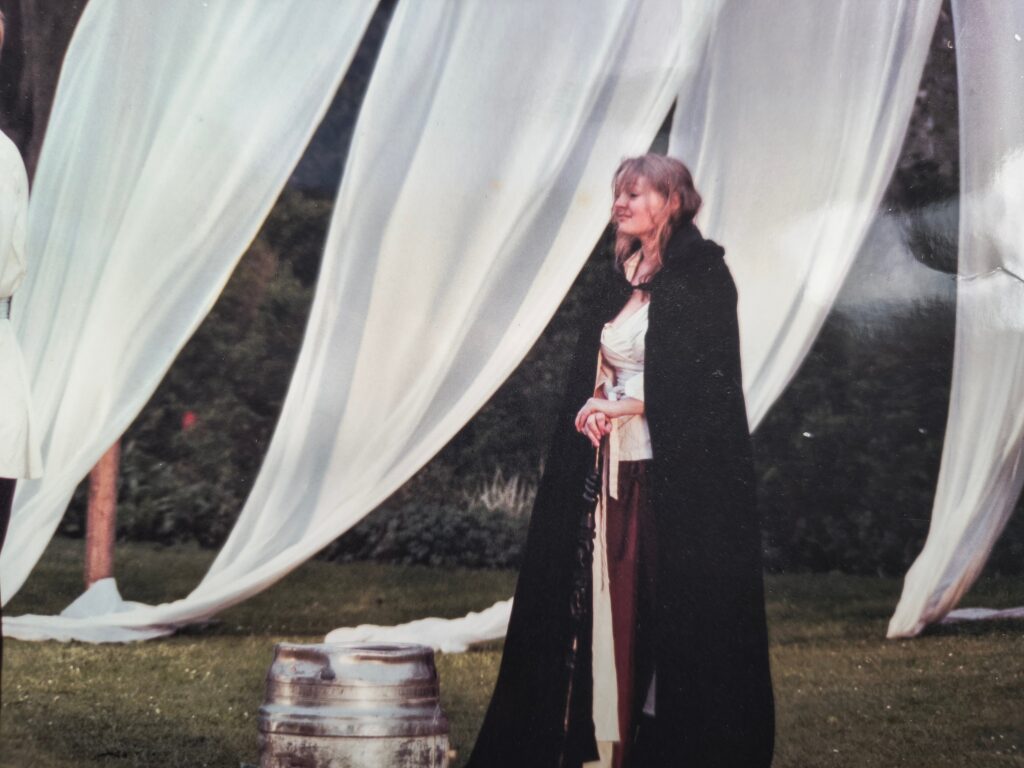
I got involved in student theatre there and met my partner, Alex, while we were performing in the Jacobean play The Woman’s Prize. My masters convinced me that I was happier responding to historical material creatively as opposed to academically, and I enrolled on the Royal Court’s Young Writers Programme. I started writing a play called The Hourglass Factory, about Suffragettes, newspapers and music hall. It was fairly chaotic and didn’t get off the ground, but between working in events jobs, a brief stint in television as a researcher on Al Jazeera’s movie show, and some travelling in Spain, I decided to try re-writing it as a novel.
After six long years of drafting, redrafting, trying to find an agent, pitching myself at events and winning a Scottish Book Trust New Writers Award, I finally landed a two-book deal with Simon & Schuster in 2014.
A creative career
I’ve spent ten years as an author now and have written five novels (including two contemporary thrillers under the pen name Elle Connel). My most recent novel, Murder Ballad, was published last year. Set in 18th-century Edinburgh, it explores the relationship between two women, a classical composer and a street ballad singer, and how the tangled pressures on each lead to an act of violence.

I always find myself drawn to writing about the intricacies of messy friendships, as well as the joys of performance and creating. I’m sure both of those trace back to my time at St Andrews where I was involved in student theatre, dance and filmmaking.


It’s not easy making a living as a writer. You have to be adaptable, comfortable teaching, able to write to commission, confident at public speaking and accept an unpredictable work schedule. It can be hard juggling the rollercoaster work while looking after our twin boys. I’m lucky enough to have been able to keep writing thanks to support from organisations like Scottish Book Trust, Creative Scotland and the Royal Literary Fund. I’m currently a Royal Literary Fund Fellow at the University of Edinburgh, so in a strange way I ended up at Edinburgh in the end.
Despite the challenges of a career as a creative, I’m glad I chose English rather than Law.
Murder Ballad was released in paperback in May 2025, published by Black & White Publishing.