From the faculty: Dr Adam Bower

Our academics in teaching and research play an integral role in the lives – and learning – of our students. Here, we hear from Dr Adam Bower, Senior Lecturer in the School of International Relations and Director of Impact and Innovation in the School, about his role and his research, which focuses on the regulation of armed violence.
Please introduce yourself and your role at the University.
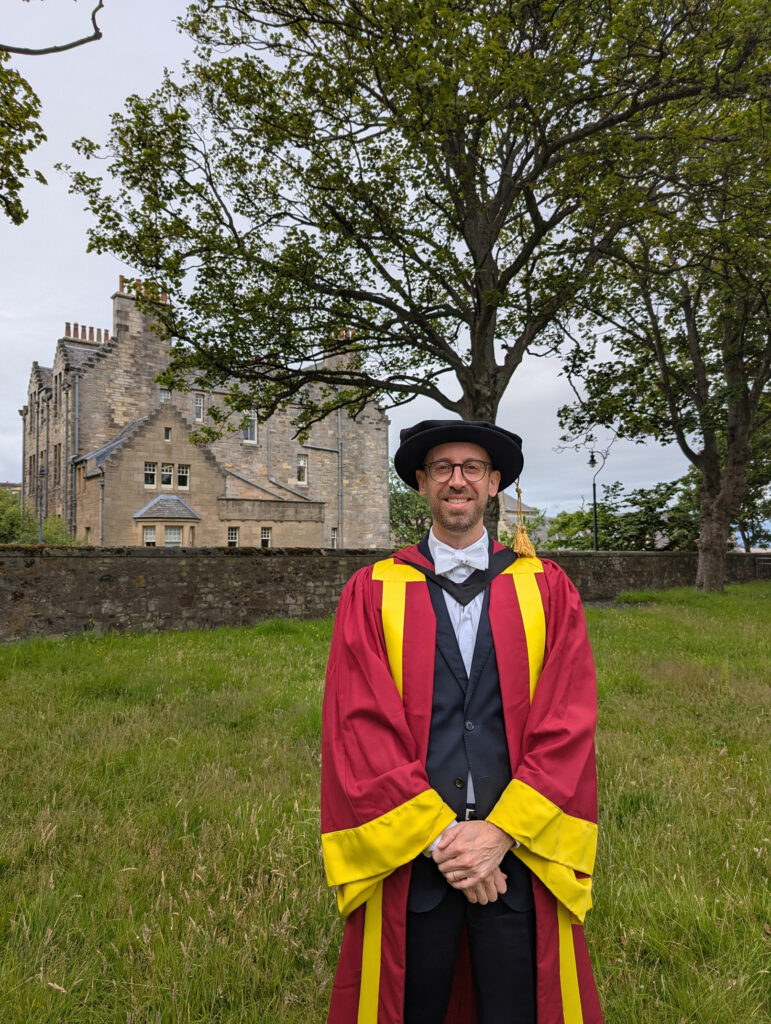
I am a Senior Lecturer in the School of International Relations (IR) and joined St Andrews in 2015. In addition to my research and teaching, I currently serve as the Director of Impact and Innovation (DoII) in the School of International Relations. In this role, I help to facilitate and promote the extensive external engagements undertaken by members of the School.
Our faculty and PhD students are conducting cutting-edge research and frequently interact with stakeholders, including local community groups, the Scottish and UK governments, foreign governments, international organisations, industry and civil society organisations. The DoII position affords me a fantastic vantage point from which to appreciate the many ways that research conducted at St Andrews contributes to positive changes in our communities and global affairs more broadly.
I was previously Co-director of the Centre of Global Law and Governance (formerly the Centre for Global Constitutionalism) and continue to sit on the steering committee of the Institute for Legal and Constitutional Research. Beyond St Andrews, I am a Fellow of the Outer Space Institute, a global network of transdisciplinary space experts; a member of the management team of the Scottish Council on Global Affairs, the first all-Scotland institute focusing on non-partisan and policy-relevant academic research on global politics and foreign policy; and an Associate Fellow of the Academy of International Affairs in Bonn, Germany.
Born and raised in Vancouver, Canada, I completed my PhD at the University of British Columbia. Following that, I completed postdoctoral fellowships at the European University Institute in Florence, Italy and the University of Oxford before joining St Andrews.
What’s your area of teaching and/or research?
My research explores how international norms and laws shape the behaviour of actors in the international system. Most broadly, I am interested in the regulation of armed violence – how human societies develop partial, imperfect, but nonetheless meaningful restraints on how we harm one another.
Much of my work has focused on arms control and disarmament (especially anti-personnel mines) and the International Criminal Court. My first book, Norms Without the Great Powers, offered a systematic, comparative study of the efficacy of multilateral treaties created in the face of opposition from the most powerful states in the international system – namely China, Russia and the US. More recently, I have turned my attention to outer space security and governance. I work with astrophysicists, planetary scientists, aerospace engineers and international lawyers to address complex challenges in the outer space domain. My current research spans a range of topics including potential restraints on anti-satellite weapons and emerging security challenges on and around the Moon.
I am fortunate to be able to bring my research interests directly into the classroom. I am teaching three modules during the 2025-2026 academic year which draw upon my current work. At undergraduate level, I teach a third-year module on ‘International Institutions and Global Challenges’ that combines an advanced study of IR theories with contemporary case studies including the UN Security Council, NATO and nuclear non-proliferation. I also teach a fourth-year module on ‘The International Relations of Outer Space’ which examines outer space as a key domain for contemporary global politics. The module uses space activities to examine key themes including great power rivalries, the nature of power and (in)security, environmentalism and sustainability, the development and impact of law, the agency of private corporations, and the potential impact of human space exploration or the discovery of alien life on our conceptions of sovereignty and political identity. In January 2026 I will launch (no pun intended) a new postgraduate module on ‘Outer Space Security’.
What are your current priorities in your role?
I am motivated by a firm belief that academic inquiry has an indispensable role in modern societies that are increasingly threatened by forms of disinformation. This begins by asserting the practical value of scholarly concepts, theories and research tools in understanding – and hopefully improving responses to – complex global challenges.
It is also important to recognise the limits of any one approach. Good scholarship and policy thus require collaborative and interdisciplinary research that also incorporates perspectives and experiences from actors outside of academia. These commitments motivate both my research and teaching. I am proud to work with brilliant transnational and transdisciplinary colleagues on projects that seek to diagnose and mitigate security risks in outer space, and on Earth. Teaching at St Andrews also allows me to help train, and learn from, the next generation of citizens who will be tasked with responding to challenges on a range of local to global scales.
Tell us about your proudest achievement.
I really enjoy the challenge of communicating research on complex current issues to different audiences. Throughout my career, I have had the opportunity to interact with governmental and non-governmental stakeholders working on critical issues ranging from humanitarian demining to the regulation of space weapons. In recent years I have contributed to submissions to the United Nations on topics relating to outer space security. I co-authored a submission by the Outer Space Institute on ‘Non-Kinetic Anti-Satellite Weapons (ASATs)’ submitted to the third substantive session of the UN Open-Ended Working Group on ‘Reducing Space Threats’ (2023).
I also contributed to a joint submission (coordinated by Dr Jessica West of Project Ploughshares) as part of the preparations for the United Nations’ Summit of the Future. Written inputs from civil society informed the development of the ‘zero draft” of the Pact for the Future’ that was negotiated and endorsed by governments at the Summit in September 2024. Our submission highlighted key challenges for outer space security and sustainability and proposed practical, achievable initiatives to enhance governance of this increasingly critical domain. I have also provided written [1 and 2] and oral evidence to the UK Parliament’s Scottish Affairs Committee on the strategic and security dimensions of the Scottish space industry.
What’s the best thing about teaching at St Andrews?
Two things really stand out which make St Andrews such a dynamic and exciting place to teach. On the one hand, we are fortunate to recruit genuinely world-class students. They come to St Andrews with diverse interests and experiences and often an urgency to see change in response to the major global challenges we are facing. As an educator, this provides ample motivation to design learning environments that can stimulate proactive engagement in the world. On the other hand, faculty are given a lot of freedom to design modules that draw from our current research interests and connect to contemporary global events. This keeps the teaching fresh and allows us to be responsive to changes in the world.
We are also encouraged to think about how we teach and treat pedagogic design and delivery as a key part of our role. For example, in my ‘International Relations of Outer Space’ module, I employ a ‘flipped classroom’ format designed to promote student leadership over the organisation and implementation of their learning. Each week, I pre-record a mini-lecture that provides context and data on the weekly topic and lays out key themes and questions to guide our subsequent in-class discussion. The seminar is dedicated to collaborative discussion and research exercises, such as investigating the connection between physics and the location of spaceports or drafting a constitution for a future Martian settlement.
What’s your top recommendation for families visiting their students at St Andrews?
It is probably a bit cliché (for good reason!), but I love a long walk on West Sands. The combination of the open space, sea air and views is exhilarating. I do my best thinking while out for a walk or run, so this is always time well spent. I don’t get down to the beach as much as I would like, but I try to remind myself to take advantage of this stunning location.
This article first appeared in LINK, our e-newsletter for Family Programme members.