Musical threads: north of the border

Paul Collins (MA 1963) shares an account of his musical experiences at the University of St Andrews, from his involvement in the Opera Group in its infancy to securing a coveted place in the Madrigal Group.
When I arrived at St Andrews early in October 1959, it did not take me long to become involved in the musical life of the University. I was particularly attracted to the Opera Group, a fledgling organisation still in its infancy but energised by a growing band of enthusiasts. I had discovered the joys of opera in my final years at school and was eager to explore this art form in more depth and increase the boundaries of my knowledge. Within a few months I was the piano accompanist in a concert performance of Purcell’s Dido and Aeneas.
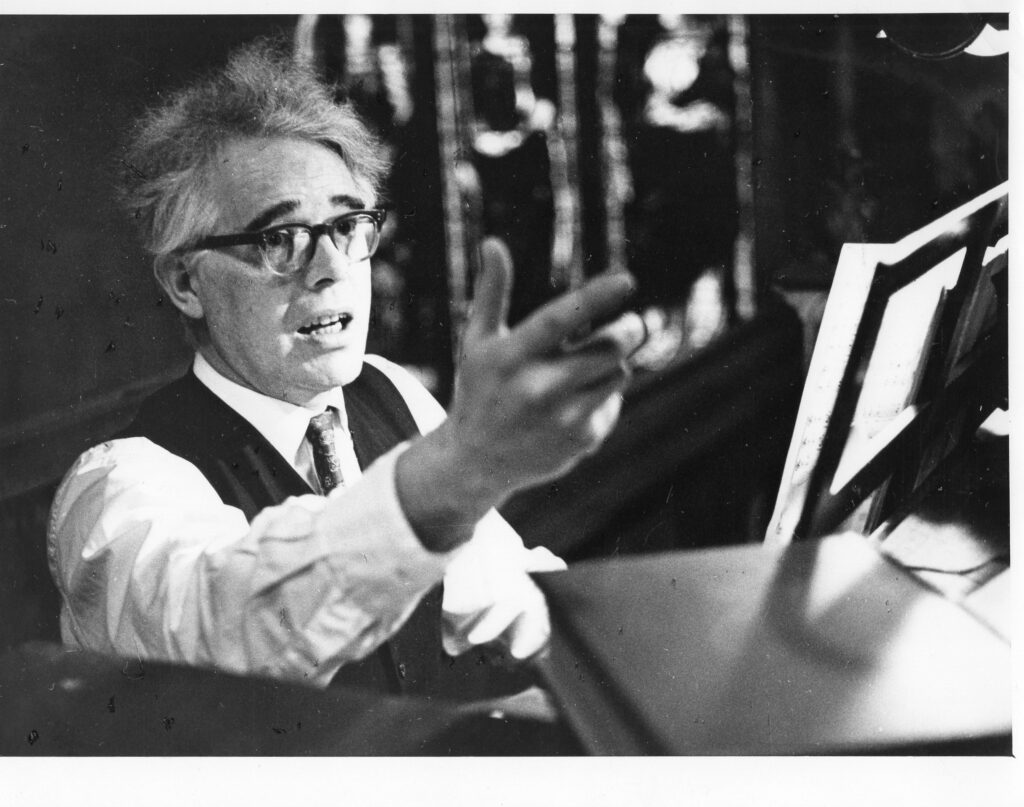
St Andrews did not have an academic Chair of Music and music degrees were not offered. However, the absence of students pursuing musical qualifications did not mean that music was absent from everyday life. Under its enigmatic Master of Music, Cedric Thorpe Davie, the Music Department flourished. Cedric recognised that the teaching and appreciation of music had taken time to re-establish itself after the Second World War, and that more and more young people were reaching universities ‘ready and eager to devote much of their spare time to the intelligent understanding and / or practice of music in one form or another, and realising, consciously or otherwise, how big a part it can play in enlarging the mental and emotional horizon and in counterbalancing some of the many unlikeable features of present-day civilisation’.
Music: a liberating experience
Cedric regarded music as a liberating experience. With his encouragement, emphasis was placed on a ‘do-it-yourself’ approach without professional support wherever possible. This had its disadvantages because it limited the technical range of musical projects which could be tackled with the expectation of reasonable success. On the other hand, the compensations were equally important, not least the sense of satisfaction that arose from testing one’s ability in the hope of achieving an acceptable outcome. I had no hesitation in embracing this philosophy and the musical freedom it brought.
I successfully auditioned as a Bass for the Chapel Choir, and a world of music of which I was unaware opened up. By comparison with other collegiate choirs, the Chapel Choir was large, with around 60 members, but it was equally at ease with polyphonic music of the 16th and 17th centuries as with contemporary repertoire. The demands on my time were not onerous, the basic requirement being a weekly Sunday service in St Salvator’s Chapel preceded by an extended rehearsal. Apart from all the music of the liturgy, I was introduced to works by Bach, Telemann, Purcell, Gerald Finzi, Zoltan Kodaly, Vaughan Williams, Mozart, Jean-Philippe Rameau, Liszt,Benjamin Britten, and many more.
The music critic of The Scotsman was a regular guest at our annual Chapel Choir concerts. In May 1960, following a performance of the Fauré Requiem, he referred to ‘the unique quality which Cedric Thorpe Davie somehow manages to obtain from this group, a quality which is in no way dependent on the building they sing in’. Two years on, and a performance of O Bone Jesu, a 19-part motet by Robert Carver, Scotland’s eminent 16th century composer, was described by Christopher Grier as ‘the most accurate performance I have heard. That is a much higher recommendation than it looks. And, like everything the St Salvator’s Chapel Choir tackled, it was full of character. When any choir includes this motet in its programme, it is a sign that no passengers are carried’. This concert also included Handel’s Dettingen Te Deum which was sung ‘with a crispness of rhythm and attack, a brightness of tone, and very adequate solo contributions’. I was one of those soloists. The anonymous student reporter went even further, describing ‘a perfectly executed passage of trumpet and solo bass with the two complementing each other exactly; the breath control of both performers must have been almost faultless’.

The Musical Society and Madrigal Group
Much activity was promoted by the University’s Musical Society. I contributed the occasional piano or vocal solo at its weekly recitals or the annual Musical Society Concert as well as a solo piano recital. But I was more comfortable acting as accompanist, which provided the opportunity to explore a wider range of music. Over the years I supported a Soprano (Anne Vaughan) in songs by Thomas Linley and Roger Quilter, a Tenor (Robin Howles) in works by Schubert, Dvorak and Brahms, a Contralto (Myra Brown) in Brahms and Wolf lieder, a Violinist (Sarah Gough) in sonatas by Bach, Haydn and Dvorak, and a Bassoonist (David Wallace) in works by Mozart, Godfrey and Thomas Dunhill. There were also piano duets by Schubert with Ken Barclay, and a two-piano recital with Ian Shearer featuring music by Mozart, Arensky, and Lennox Berkeley.
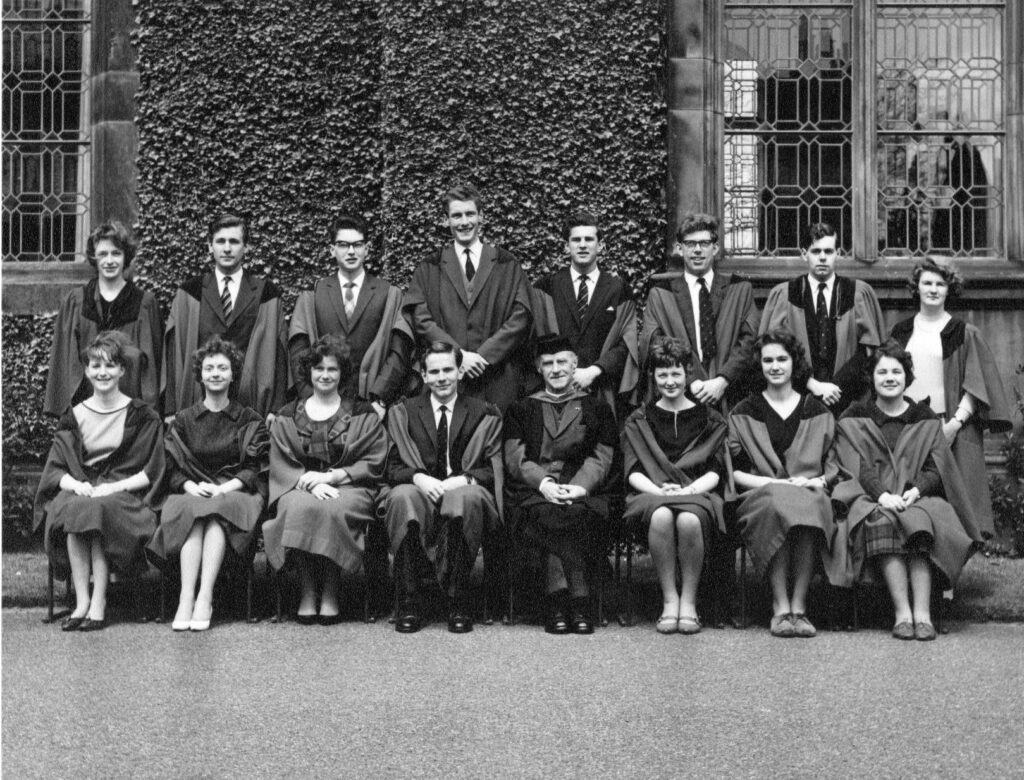
Standards of performance at these events may have been variable but you would consistently be rewarded by the singing of the University Madrigal Group. With only 14 singers, competition for places was intense, and vacancies usually arose only when a member graduated. I was eager to be admitted to this elite group, but I had to wait until my final year before breaking through into the ranks of the basses. Even then, one of the Group’s basic rules of admission had to be waived as I was only able to complete one year of membership when the expectation was for a minimum of two. Singing with the Madrigal Group was the perfect antidote to the more formal regime of the Chapel Choir.
Opera on a shoestring
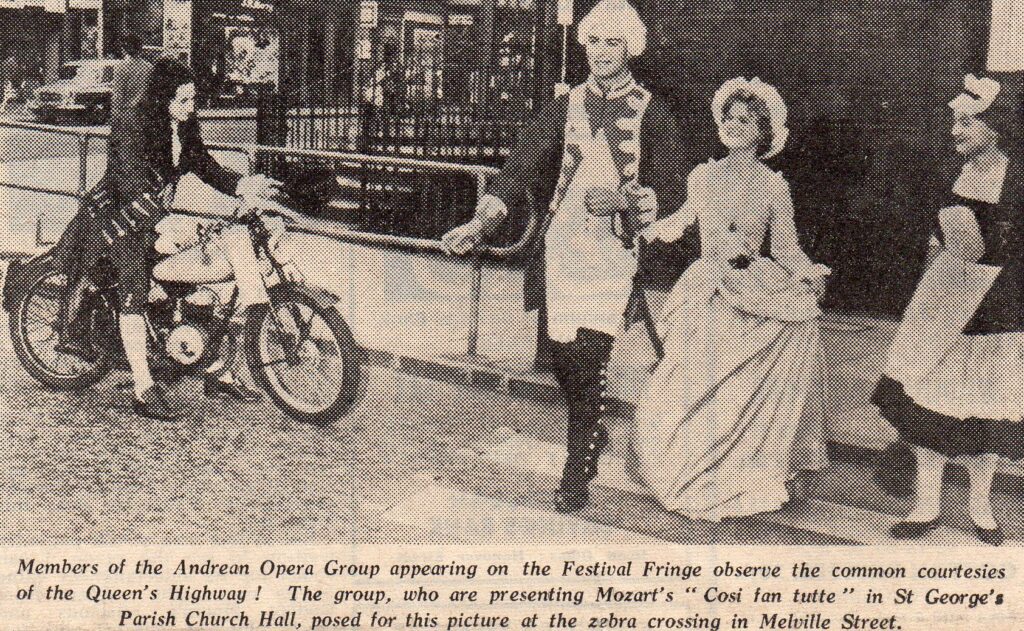
Madness! Utter madness! What were we thinking? On 25 August 1961 in St George’s Parish Church Hall in the West End of Edinburgh, the curtain ‘went up’ on a staged and costumed performance of Mozart’s opera, Cosi fan Tutte, by the Andrean Opera Group. Our objective was to present opera as inexpensively as possible and to give performances which, despite lacking lavishness, were nevertheless capable of providing enjoyment for audience and performer alike.
From a stuttering performance of Dido and Aeneas in Lower College Hall 18 months earlier, the University’s Opera Group was now parading itself on the Fringe of the Edinburgh International Festival, the first operatic group ever (we understood) to stage a Fringe production of this nature. In those days there were seemingly no controls and no central co-ordination, and the Fringe then was far from the professional megalith of modern times. But Mozart? And one of his greatest and most loved operatic achievements? We were certainly ambitious; we were probably also naïve, although we did not underestimate the problems we were likely to face.
The choice of Cosi was certainly feasible, as it only had a cast of six, and could be adapted easily to exclude the chorus which added nothing to the story and whose musical contribution was minimal. However, all the soloists had to be of equal stature and ability. The production was to have a piano accompaniment, which was common at the time and consistent with the Arts Council’s ‘Opera for All’ scheme whereby groups of professional singers and a pianist took opera to those parts of the country which lacked access to, or facilities for, fully staged productions. I was the pianist for this inaugural operatic challenge.
We had a ‘run-through’ the previous November with a concert performance in St Andrews which even the University critic agreed was successful, even if the singers’ vocal techniques were understandably not quite up to Mozart’s demands. Unfortunately, by the time we reached Edinburgh we had to recast the tenor role and were obliged to engage another singer from outside the University.
In the event we acquitted ourselves satisfactorily and justified the decision to attempt a work of such magnitude. The Scottish Daily Mail recognised our limitations and reported that, ‘although it was opera on a shoestring, the voices were strong and true. The Group is lucky in its pianist, Paul Collins, who never faltered’! The Glasgow Herald reviewer, under the heading ‘Amateur Opera at its best’, commented that ‘if it is an amateur production, it is amateur in the best sense of that word, for the whole proceedings are suffused with a love of Mozart’s music; there is relish on both sides of the curtain’. The review went on to suggest that, while ‘there is plenty for the carping critic to catch on to’, and ‘the ensemble balance is sometimes upset by the unevenness of the voices themselves, all the work is so well known and so thoroughly rehearsed that blemishes can be quickly forgotten, and the spirit of good humour and competence remembered’. The Scotsman was less complimentary, maintaining that ‘amateur operatic performances can reach a much higher standard, particularly at an International Festival’.
Emboldened by its achievements, the Andrean Opera Group returned to Edinburgh in 1962 with Nicolai’s The Merry Wives of Windsor. I was cajoled into singing the role of Ford in a production which was ‘entirely successful in its laudable aim’ (Edinburgh Evening News), provided ‘an evening’s amusement for anyone in the right frame of mind’ (Scottish Daily Mail), and where ‘deficiencies matter little if the spirit is there, and can even be endearing’ (Scottish Daily Express). Only The Scotsman, as in the previous year, found us wanting, although it accepted that nobody should ‘deny the courage of the company, nor its intelligence and the many aspects of its musicianship’.
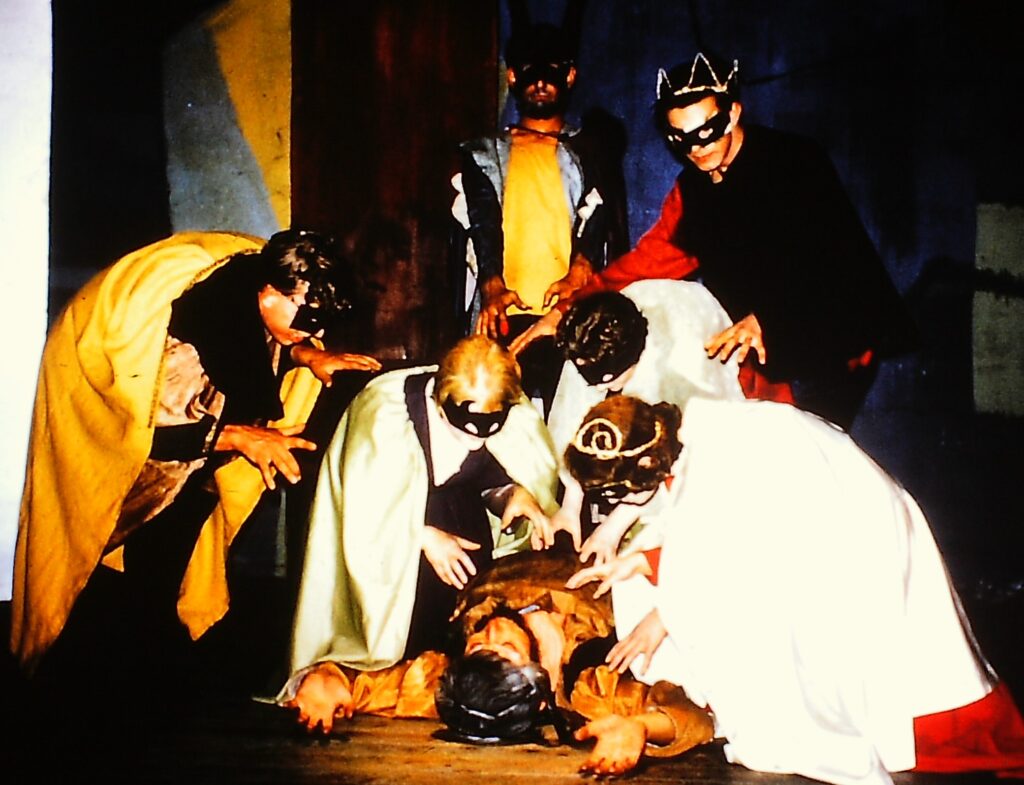
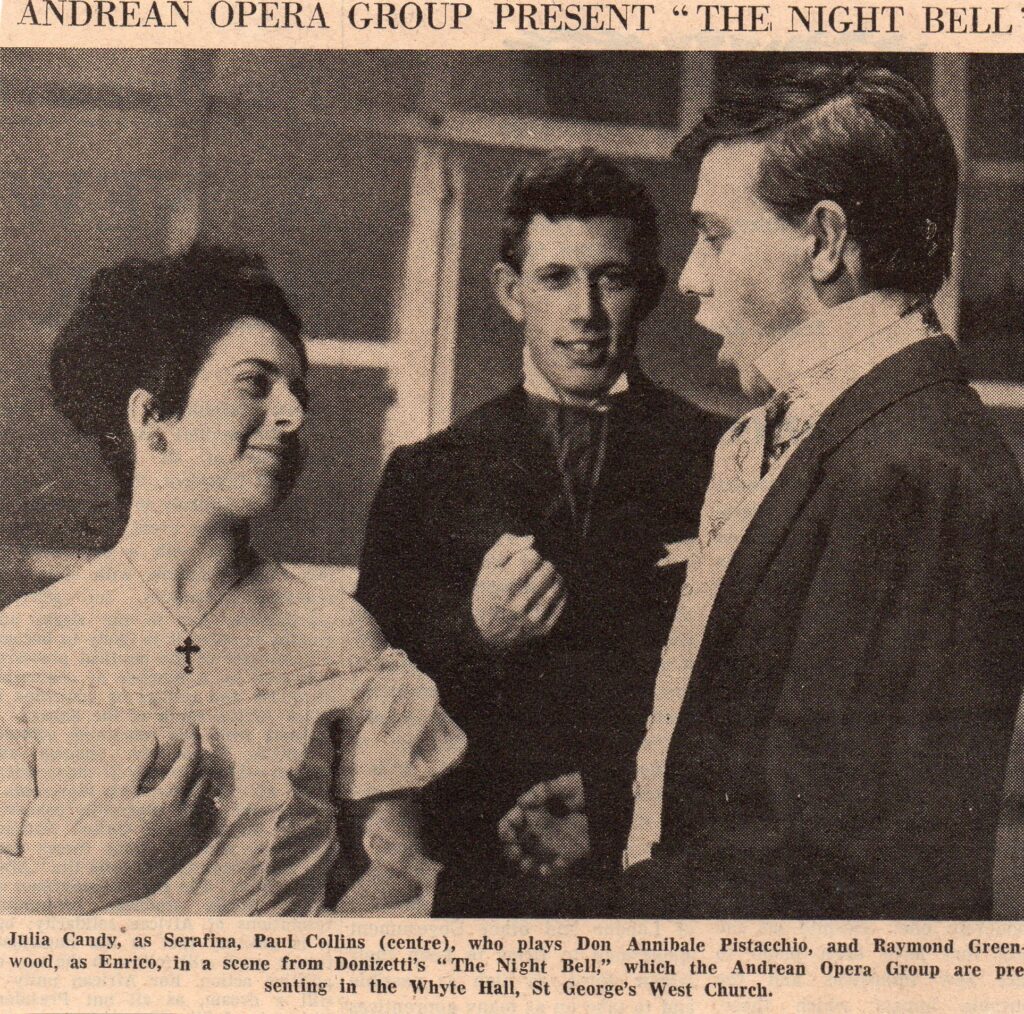
A few weeks after graduating in June 1963 I paid my final visit to the Edinburgh Festival Fringe when the Andrean Opera Group presented a double-bill comprising Mozart’s Bastien und Bastienne and Donizetti’s Il Campanello di Notte, in which I again sang a principal role. For the first time, The Scotsman came to terms with what the Group was trying to achieve when ‘an efficient small chorus’ (of eight singers) ‘made itself felt’ in the Donizetti opera and ‘the ensembles were suitably cheerful’.
I returned home from Edinburgh not knowing what the future would hold. But I had no doubt that the foundations had by now been firmly established of what would turn out to be a fulfilling love of music and a lifetime of choral singing.