Saints Spotlight: Professor Sabine Hyland

Professor Sabine Hyland is a Reader in the School of Divinity. In this month’s Saints Spotlight, she discusses her research into an Indigenous Peruvian form of proto-writing made of knotted, mixed-fibre strings known as khipus and the previously uncovered knowledge they could hold about the Inca Empire.
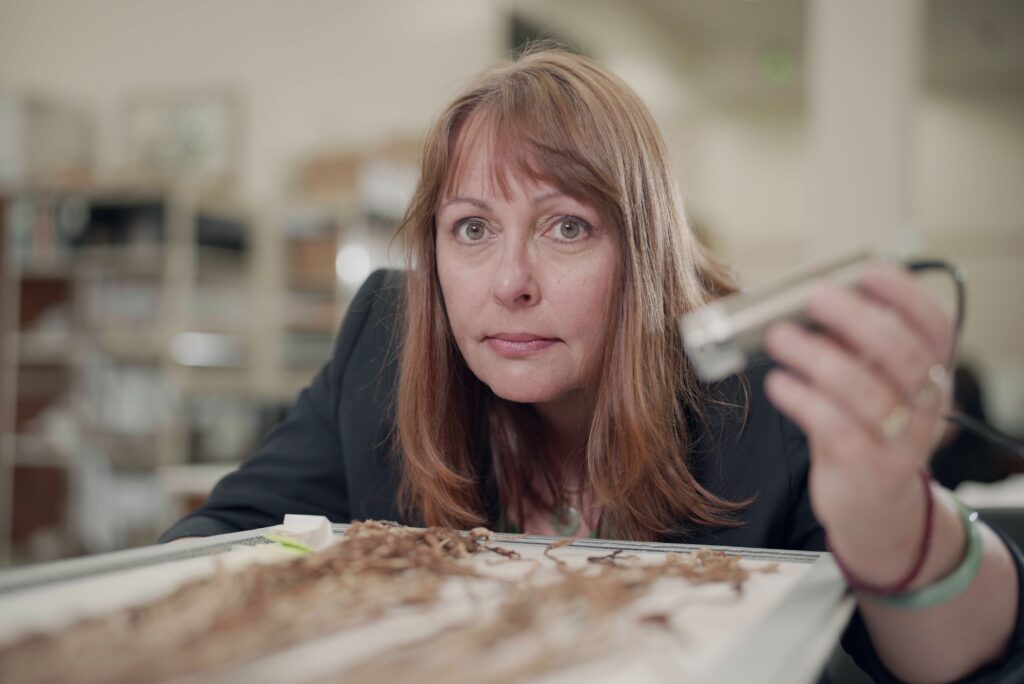
How did your St Andrews story start?
I received an email inviting me to submit an application for a senior position in the Department of Social Anthropology. I applied and was delighted to be hired; my husband Bill, who holds a doctorate in Medieval Church History, was hired as a lecturer in the School of Divinity at the same time. Eventually, it turned out that Divinity was a better fit for my research, which increasingly focuses on the sacred Indigenous texts of the Americas. While I miss many of the great people in Social Anthropology, Divinity has become my true intellectual home.
What are your current priorities at the University?
My three current priorities are research, teaching and impact.
What is the focus of your research at St Andrews?
I collaborate with elders in remote Andean villages to learn new insights into how Indigenous Peruvians communicated through 3D coloured cords known as khipus.
I’ve uncovered isolated communities where khipus – once thought to have been wiped out during the European invasion – were used in living memory. The Incas, the largest empire of the Americas, kept their accounts, histories and sacred knowledge on khipus. If we could decipher these knotted cords, we would gain an insider’s view into Inca life and religion.
Tell us about your proudest achievement.
Last year, the Indigenous authorities of the Andean village of Jucul, Peru, invited me to see their ancestral khipus, which had never been shown to outsiders. When I visited the community last summer, I discovered that they had over 90 khipus stored in plastic rubbish bags, where they are vulnerable to damage from mould, insects and rodents.
With funding from the British Museum, I have begun a project – in collaboration with the community – to document, clean and preserve the khipus. We intend to display the khipus in the local Jucul museum so that the youth in the village can learn their traditions, and – hopefully – attract tourism.
At the end of my stay in Jucul last summer, the village president gifted me a shawl decorated with traditional designs, handwoven with handspun yarn from their own alpaca herds. He explained to me that this meant that I was now a member of their community – a true Juculina – and should consider Jucul to be my home.
Where is your favourite spot in St Andrews?
My office window looks out onto a walled 17th-century garden. It was the original site of the town’s botanical garden and is filled with exotic flowers and plant species. Right under my window, there’s a medieval well known as Druid’s Well, with a heritage apple tree standing watch over it. I love to wander through the garden and then sit by the well, making a wish.
Inspired by her work in Andean textiles, Sabine also practises tapestry weaving – she is featured in the upcoming exhibition ‘Picking up the Thread: The Past, Present and Future of Tapestry’. The Exhibition at Dovecot Studios, 10 Infirmary Street, Edinburgh runs from 20 October 2025 to 14 February 2026, from Monday to Friday, 12pm to 3pm and Saturday, 10am to 5pm. Find out more about the exhibition.