Donor Story: The RS Macdonald Charitable Trust

The University of St Andrews has an international reputation for high-quality neuroscience research, with academics publishing in top-tier journals including Nature, Science, Cell, and Nature Neuroscience. In the Guardian University Guide 2026, St Andrews was ranked second only to Oxford for Biomedical Science.
Driving discovery
The RS Macdonald Charitable Trust’s support for neurological research has played an important part in establishing the University as a centre of excellence in neurophotonics. Their St Andrews Seedcorn Fund for Neuroscience supports early-career researchers (ECRs) who are conducting pioneering work on systems neuroscience and neurodegenerative disease, for example using light-based technology to investigate biological processes at molecular, cellular and whole-systems levels. This research is directly applicable to our understanding of numerous neurological disorders including Dementia, Alzheimer’s Disease, Motor Neuron Disease (MND), Amyotrophic Lateral Sclerosis (ALS), Spinal Muscular Atrophy, autism and strokes.
At St Andrews and beyond, the Scottish Seedcorn Fund for Neuroscience, also supported by the RS Macdonald Charitable Trust, is supporting ECRs at institutions across the country, enabling meaningful progress to be made in three key areas – Discovery Sciences, Clinical Studies and Care in the Community. The projects it supports are designed to offer collaboration across Scottish centres.
The partnership between the RS Macdonald Charitable Trust and the University of St Andrews has been growing for more than 15 years. The sustained support and investment in building a nexus of neurophotonics research saw the establishment of a stand-alone Centre of Biophotonics in 2019. The Centre promotes interdisciplinary research and training at the interface between advanced optical imaging, photonics and biomedical sciences. It integrates researchers across four schools (Physics and Astronomy, Medicine, Biology and Psychology and Neuroscience) and builds on existing strengths in the development and application of light-based technologies to investigate biological process at molecular, cellular and tissue scales.
The people behind the progress
Among the ECRs driving discoveries at St Andrews is Dr Matthew Broadhead, who has received over £32,500 in funding in four awards across the two seedcorn streams.
The support has had an immeasurable impact on the development of Dr Broadhead’s early neuroscience career. He is currently a research fellow in the University’s School of Psychology and Neuroscience.
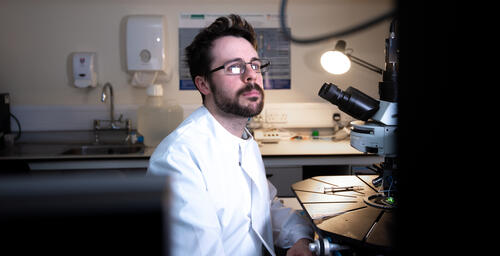
“My research focuses on understanding how nerve cells communicate with one another through chemical connections called synapses, and why these connections are particularly vulnerable to damage in diseases such as Motor Neuron Disease (MND),” Dr Broadhead explains.
“With support from the RS Macdonald Charitable Trust, I am now investigating a recent discovery in the spinal cord: a previously unknown type of synapse that connects directly to motor neurons – the nerve cells responsible for sending signals to muscles and allowing movement. Remarkably, this newly identified synapse is around five times larger than a typical synapse. Because of its distinctive appearance, featuring a complex, honeycomb-like structure with many small holes, we have named it the ‘Honeycomb Synapse’.
While ongoing laboratory studies are revealing many intriguing features of this synapse, one of our most important findings so far is that Honeycomb Synapses appear to be especially vulnerable in models of MND. In some cases, they are almost completely and selectively lost.
According to Dr Broadhead, “This suggests that damage to these synapses may play a significant role in the progression of the disease. We hope that this research will guide future work aimed at protecting Honeycomb Synapses, with the long-term goal of developing new treatment strategies for MND.”
A particularly rewarding aspect of this research has been the opportunity to share the discovery of the Honeycomb Synapse with undergraduate and postgraduate students in the laboratory.
“The students have been highly galvanised by this finding and are now actively pursuing their own research projects in this area,” adds Dr Broadhead. “Their enthusiasm has helped to drive the work forward, with the shared aim of advancing scientific understanding and, ultimately, improving the lives of people affected by MND and other spinal cord disorders.
“I am deeply grateful to the RS Macdonald Charitable Trust for their support in enabling this exciting and promising line of research.”
Dr Vanya Metodieva (BSc Hons 2016; PhD 2021) completed her postdoctorate at St Andrews and has received support from the St Andrews Seedcorn Fund for Neuroscience. After a stint at the Scottish medical technology company Carcinotech, she has returned to the University as a research fellow in the School of Physics and, in December 2025, was awarded further support for her research into early-stage Alzheimer’s disease.

“Alzheimer’s is a global crisis, affecting over 50 million people worldwide, and we’ve known for a long time that a protein called amyloid-beta is at the heart of it,” Dr Metodieva explains. “But here’s the thing: not all amyloid is the same. My work focuses on the ‘early-stage’ aggregates, the small, toxic versions that start quiet chaos in the brain long before major symptoms appear. These proteins essentially ‘jam’ the signals between neurons, specifically disrupting long-term potentiation, which is how our brains actually wire new memories.
“With the help of the RS Macdonald Charitable Trust Seedcorn Fund, I’ve been using live imaging and light-based tools to observe this happening in real-time. We’ve been able to see exactly how different shapes of amyloid break neural circuits in different ways. It’s not just one blanket problem; it’s a specific mechanical failure we’re finally starting to map out.”
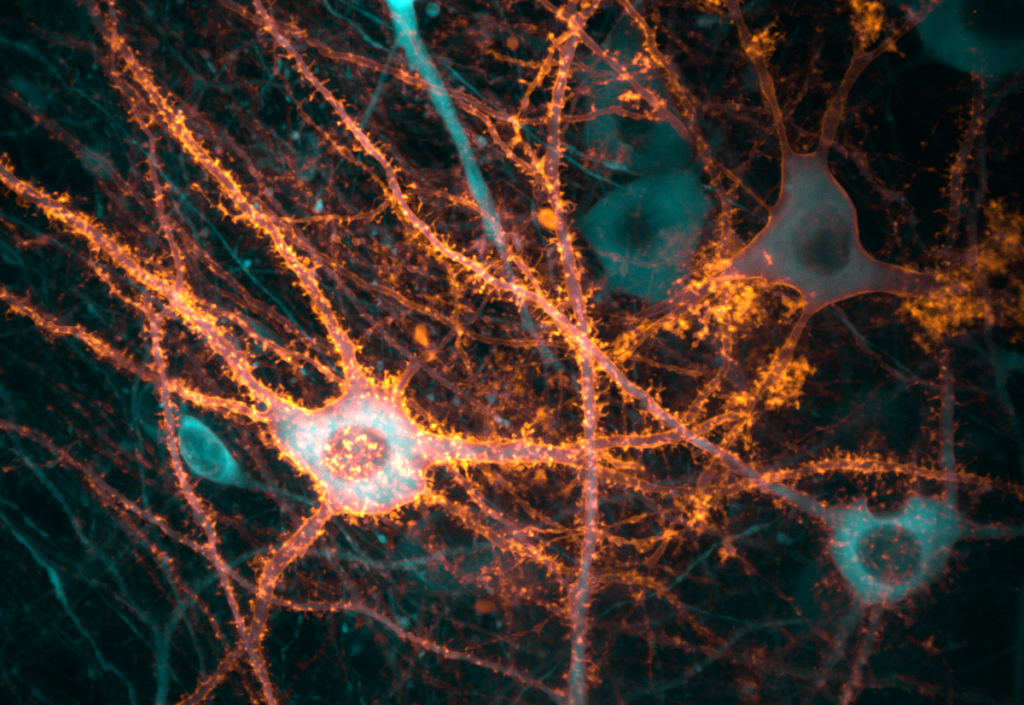
However, understanding the damage is only half the battle. “I’ve also been looking at the brain’s ‘waste management’ system,” adds Dr Metodieva. “We used to think the brain was somewhat isolated, but we now know there’s a complex drainage and immune network in its outer lining. Thanks to the Seedcorn Fund, I developed a way to record how the brain tries to flush out these toxic proteins and which immune cells show up to help.
“By looking at both the molecular ‘glitch’ in memory and the larger system-wide failure to clear the waste, we’re getting a much clearer picture of how Alzheimer’s takes hold and more importantly, how we might actually stop it.”
Cutting-edge neuroscience enabled by philanthropic support
Professor Frank Gunn-Moore of the School of Biology at the University of St Andrews leads the Scottish Neuroscience Research Fund (SNRF), which has been generously supported by the RS Macdonald Charitable Trust through three rounds of grant-making to date, and was jointly established through a funding partnership with the CSO (Chief Scientist Office). Through the Fund, Professor Gunn-Moore and an interdisciplinary team from across Scotland assess applications for funding for projects that will drive meaningful progress in dementia research.
These projects demonstrate the transformative impact of the RS Macdonald Charitable Trust’s sustained investment in early-career researchers across Scotland. By empowering scientists at pivotal moments in their careers and enabling inter-institutional collaboration, the Trust is helping to unlock new discoveries, accelerate innovation, and build the foundations for future breakthroughs in the understanding, prevention and treatment of neurological disease. As the partnership continues to grow, so too does its potential to improve lives, both through research from the University of St Andrews and beyond.
The University of St Andrews is grateful to the RS Macdonald Charitable Trust for their continued support of early-career researchers and neuroscience research at the University.
Find out more about supporting the University’s Making Waves Campaign, including driving research through philanthropic support.