St Andrews: an escape and an awakening

Liz Gerschel (MA Hons 1972) was one of the first women to walk in the Kate Kennedy Procession and has spent a lifetime campaigning for race, gender and disability equality. She remembers decorating the halls of Abbotsford House, breaking the mould by studying female authors at a time when they didn’t feature on the curriculum, and participating in student productions galore.
I am a Londoner and live in Camden, near Primrose Hill. I came up from London to St Andrews in 1968, a year ‘late’ having worked on Fleet Street in public relations after leaving school and was the first in my family to go to university.
My school years were spent at the City of London School for Girls, where I held a scholarship, and I liked the tradition of it – and a bit of pomp and ceremony. It gave me stability in an unstable family.
I chose St Andrews, sight unseen, for two reasons: it offered me a place, and it’s a long way from London. I loved the history and beauty of the town – and the wild coast – and I couldn’t believe my luck.
Academic approaches
I read English at St Andrews – my favourite subject. Unwisely, I hadn’t researched the English Department in advance and was disappointed to discover that at that time there were no female staff and almost no women authors mentioned, let alone studied. I was a feminist through and through, and when I chose the works of Elizabeth Gaskell as a special subject, I was unwilling to change my mind when the late Professor Falconer expressed his great disappointment.
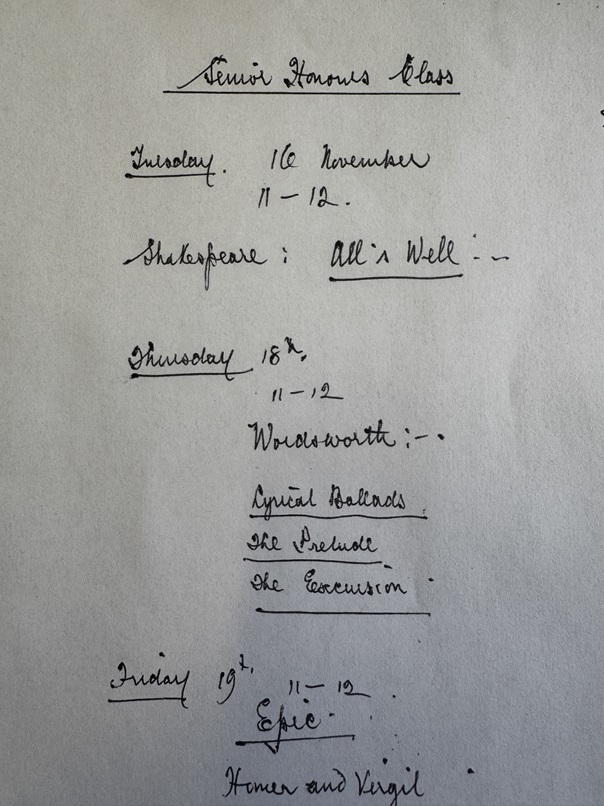
I took French for two years, which was a pleasure, and Moral Philosophy for a year, which was a challenge. I also studied Art History with Professor John Steer, which was a life-changing experience for one who loved art, not least because of his generosity with his time, his knowledge, and the warm welcome to his home for lively group discussions.
I loved academic life and recognised St Andrews as a context for learning which combined the challenge of traditional and new approaches. For me, St Andrews was not only an escape, but an awakening.
The Abbotsford years
As a bejantine, I was lucky to have a place in Abbotsford House, a student residence converted from a hotel. I formed a close group of friends who proved invaluable when, in the first week of the second term, January 1969, my 18-year-old brother died suddenly. Despite the instruction from the Warden to my friends not to talk to me about it, those friends – a bunch of loving amateur psychologists – did talk. They helped me to get over the shock and kept me going.
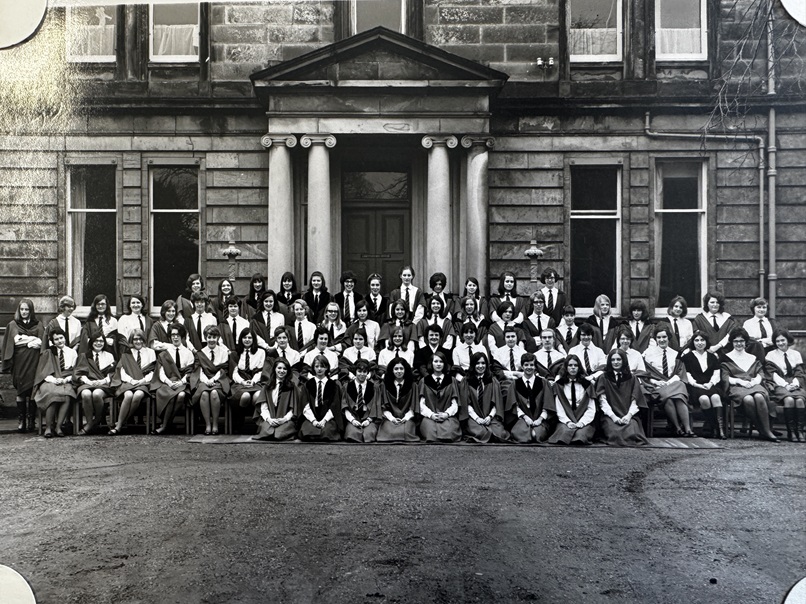
I received an amusing sequence of formal, albeit tongue-in-cheek, notes from that same warden requesting the removal from the Abbotsford premises of a pram, in which I had spent Raisin Monday. Perhaps the wrong message for a women’s residence.
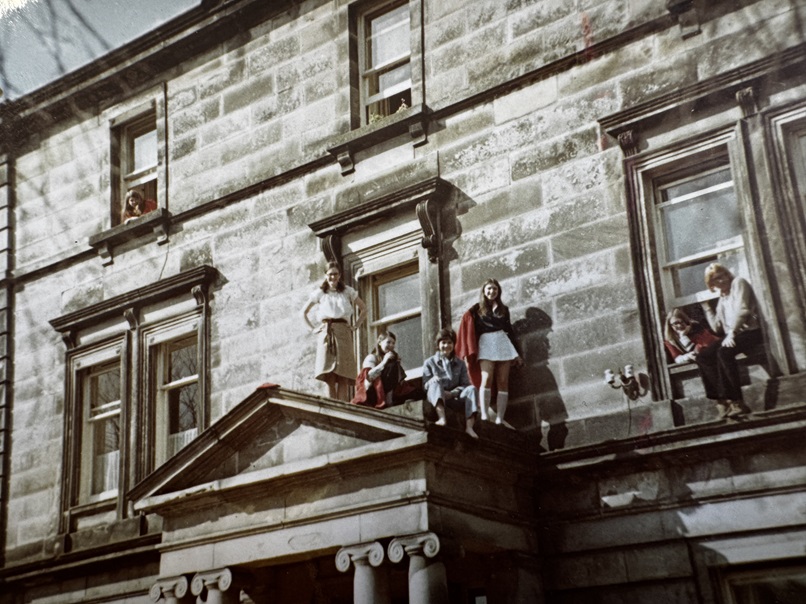
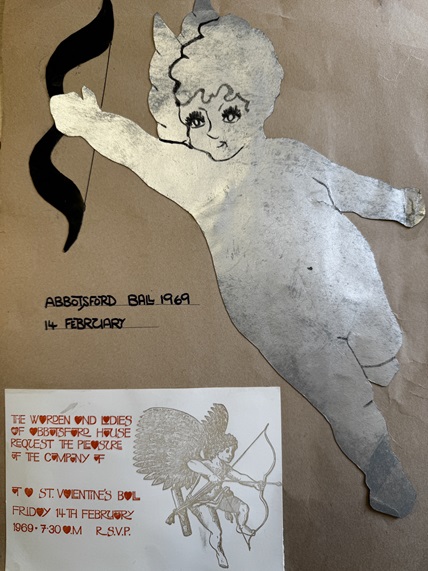
I stayed in Abbotsford for two years, building many friendships that have lasted over 50 years. In my first year, I was a designer for the Abbotsford Ball, which involved a hundred or more silver-painted, cut-out cupids, which decorated the stairs and murals in the halls for Valentine’s Day. We had a team of painters and cutters, and it looked splendid!
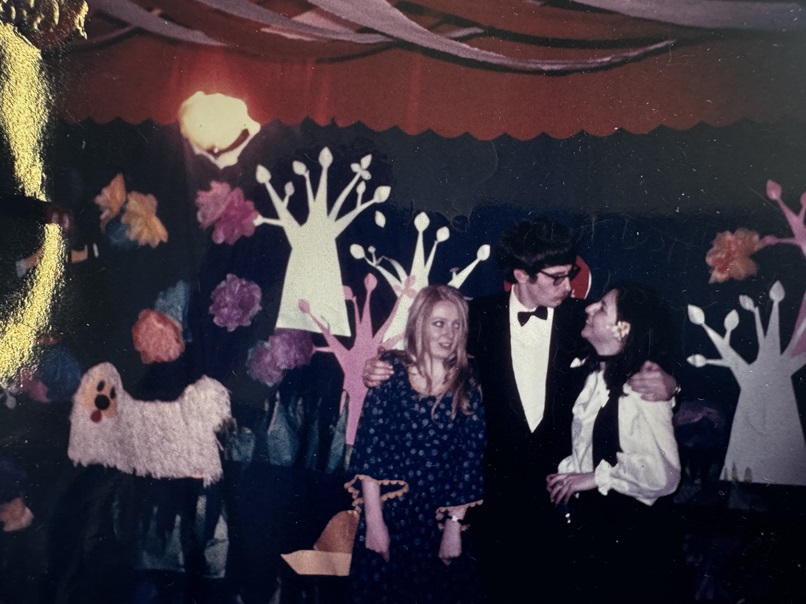
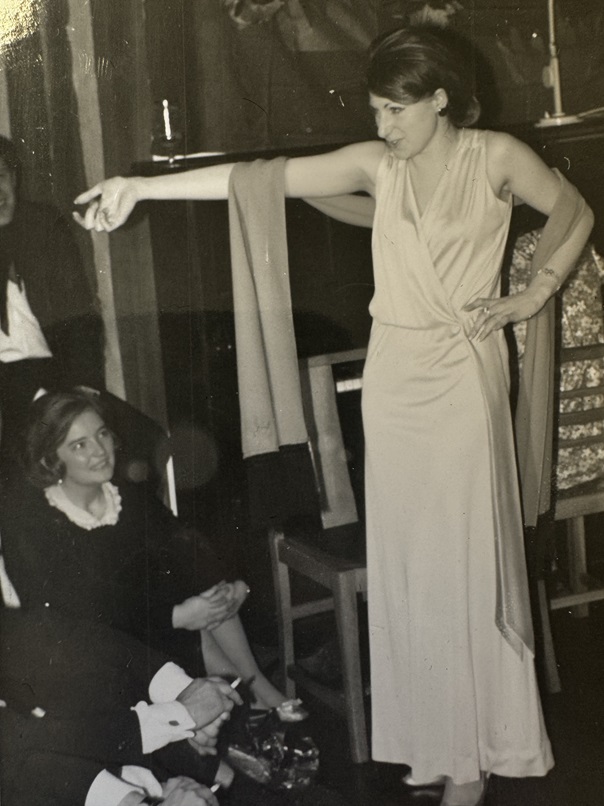

In my third year I moved to a mixed basement flat in 9A Hope Street and met the formidable but kindly landlady, Mrs Stewart, legendary among students. Mrs Stewart was good to us, ignored the football boots in ‘my’ room and gave me a beautiful piece of gold and black satin to make into an evening dress for the Graduation Ball.
Phoenix, Mermaids and French productions
In September 1968, I became a member of the Phoenix (Literary) Society, the President of which was my Senior Man, Paul Jean (JP) Creton (MA 1970). I found myself immediately elected as Secretary.
I wrote various reports in Aien, the student newspaper, some of which reveal the gender-consciousness and feminist fight that was important to me.
I was also a Mermaid, and the Society proved very important in my University life. It remains so half a century later, through many friendships and gatherings such as the 50th Mermaid reunion in 2017 in St Andrews, and annual trips to see plays directed by a friend from the Byre.
I loved theatre and directed the annual French play, L’Alouette by Jean Anouilh, in my second year. The challenges were finding 23 French-speaking actors, filling the cavernous space of the Buchanan Lecture Theatre with minimal sets, providing costumes, and pulling it all together, which I did thanks to the help of a brilliant stage manager, Buz Williams (MA 1973), and Catriona White (MA Hons 1972) as Jeanne. Even a medic housemate, who had the size and presence to be a convincing general, was coerced into rehearsing a five-word speech while he cooked his breakfast. The Senior French Lecturer, Dr Sam Taylor, now Professor Emeritus, who taught me and nominated me to direct, wrote that it was ‘the best (French) production we have seen in years’.
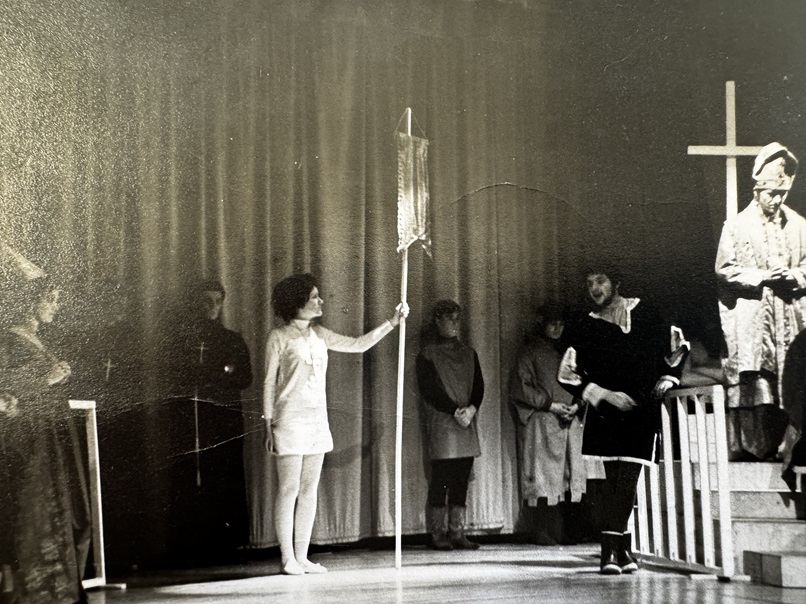
My first directing experience at St Andrews was a one-man play about loneliness and difference, called Only Instant, which was written by Mark Bunyan (MA Hons 1971), later renowned in musical theatre and cabaret. I was involved in several other productions both on stage and with make-up and costumes.
As students we benefited from the Byre Theatre, which was so small that a notice asked patrons in the front row to keep their feet off the stage! It offered us professional models of acting, directing and theatre work, a wide range of plays, and the occasional loan of props. Some actors became friends.
Women in the Kate Kennedy Procession
When I matriculated in 1968, I regarded the Kate Kennedy Club as a boys’ club, to which many of the interesting male students belonged, and to which female students, however interesting, did not. It seemed to me to have a number of rules and traditions, a degree of exclusivity, and its members did some laudable charitable deeds.
What struck me was that the annual Kate Kennedy Club Procession celebrated persons notable to St Andrews’ history, all of whom were played by men, including the Lady Katherine, niece of Bishop Kennedy. Watching the very few women characters included be played by men (often in jest, to the amusement of the crowds) raised my feminist hackles. And so began the campaign to include in the Procession more women who had contributed to the history of St Andrews, and to see them portrayed by women.
As it transpires, a fellow alumna, Sue Anstruther (MA 1971) had been smuggled into the 1971 Procession as a page to King James I & VI, but it wasn’t quite ‘official’.
In 1972, despite some mixed feelings among Club members, four notable female characters were, officially, played by women. It was a small victory in terms of recognising the contribution of many interesting women to St Andrews’ history, but it was a very important indicator of change towards gender equality and respect. I played the sainted Queen Margaret of Scotland (1045-1093), wife of King Malcolm III (Malcolm Canmore), known for her charity and compassion for orphans and the poor. Commendably, she also established the Queen’s Ferry over the Firth of Forth to improve access to the shrine of St Andrew and introduced the demarcation of Sunday as a day of rest and prayer, practical contributions to progress that matter today. My pagegirl was Penny Hall, daughter of a lecturer; Mary, Queen of Scots was played by Erica Robb (MA Hons 1973); Elizabeth Garrett Anderson by Lindsay Miller (MA Hons 1973) and Mary Ann Baxter, benefactor of the University, by Susie Innes (MA Hons 1974).


Sadly, I understand the new order was not maintained the following year, although it was later reinstated, and I was pleased to read the reflections of the first female President of the Kate Kennedy Club, Emma Andersson (BSc Hons 2025) published in anticipation of the Club’s centenary this year and celebrating its evolution.
A commitment to making a difference
I had always wanted to teach English and was deeply committed to education making a difference. After I graduated in 1972, my then-partner, David Jones (MA Hons 1971), and I went to the University of Bristol to gain the PGCE, both with the intention of becoming secondary school teachers.
Early on, I questioned differences in the treatment of male and female students, for example, in receiving small support grants in the holidays (men, yes, women, no). I persuaded Bristol that equity was essential and they agreed, making provision for women.
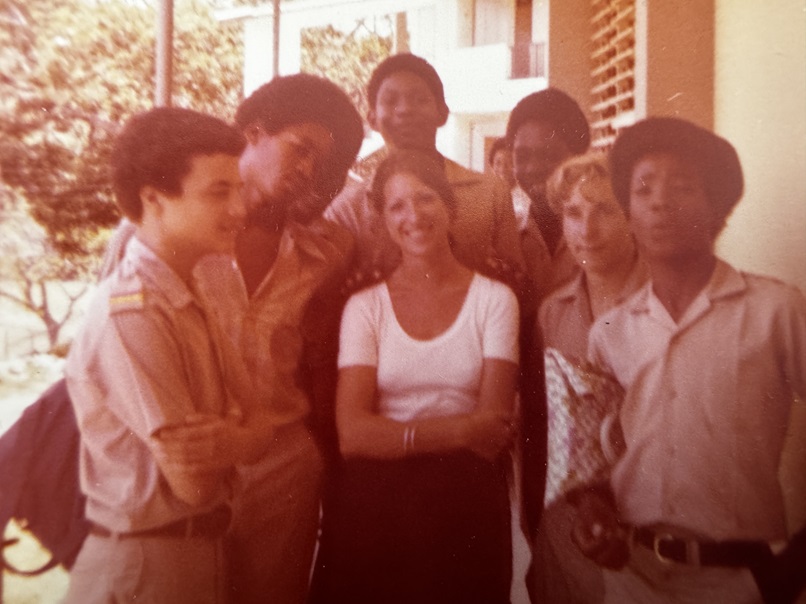
I worked on a 1:1 project, run by Bristol, supporting pupils who were finding school difficult. The 12-year-old Jamaican student with whom I worked had recently arrived in Bristol and found that she did not fit into her parents’ new family of Bristol-born siblings. I tutored and supported Barbara and she changed everything for me. I became more aware of difference, race and prejudice and their effects in schools, and this led me to spend time teaching in Jamaica’s Cockpit Country. I fell in love with Jamaica and studied and taught Jamaican, and other Caribbean and African literature, in difficult conditions. At A-Level, the Sixth Form had only six copies of William Makepeace Thackeray’s Vanity Fair between 12 girls; no libraries, no sources of information beyond my teaching, no electricity, and in the evenings they read and wrote by the light of oil lamps. Huge moths known as ‘rat-bats’ gathered around them, terrified the girls and interrupted their flow of thought. Regardless, they all passed A-Level.

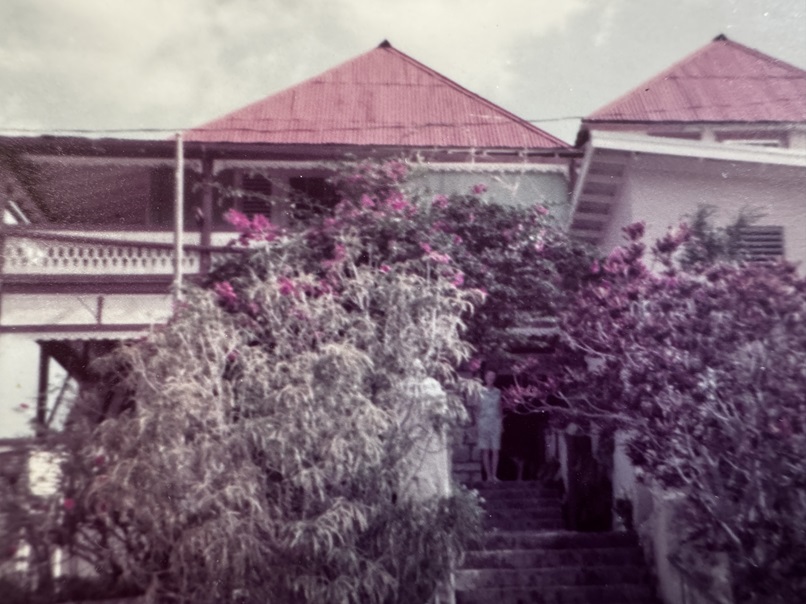


I went on to teach at a boys’ school in Montego Bay, where I did my best to challenge misogyny and sexism in the classroom and staffroom.
Back home again
I returned to Camden, where I taught English at Parliament Hill School. When, in 1979, the Queen made her first visit to a London comprehensive, she was shown to my classroom, where the pupils were deemed unlikely to pass O-Levels. Many were Black or mixed race, and we were studying a poem on prejudice. After Her Majesty’s (unnerving) visit, I discovered – and closed down – a betting book that one of the girls was running before the lesson on what colour the Queen would be wearing!
In the late 1970s, I was a founder member of the Association for the Teaching of Caribbean and African Literature (ATCAL), which later included Asian and other literature. ATCAL ran successful national conferences attended by several well-known authors, dramatists and poets, furthering awareness of Black Literature. We also put on plays for schools at our base, the Africa Centre in Covent Garden.
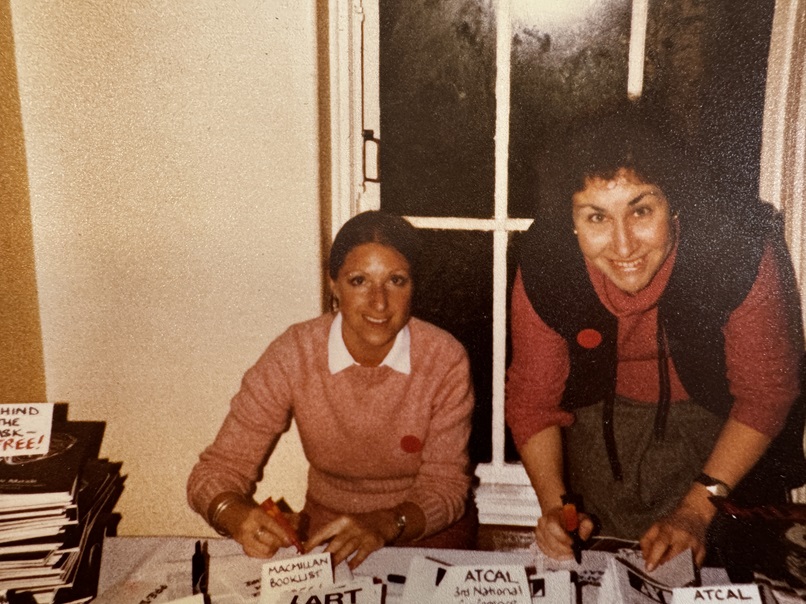
I worked hard to change attitudes in schools to better reflect and include the cultures of the pupils and their parents. It was a time of growing recognition of Caribbean and African languages and their impact, and I was able to undertake this challenge thanks to the support of Howard Williams HMI (Her Majesty’s Inspector), who was a Welshman heavily committed to teaching Black literature. He sent me around the country as an advisory teacher, bringing with me a suitcase of books by and about Black people. Through this hands-on approach, I persuaded many a school, local authority and training course of the value of literature that reflected diverse cultures. Classrooms were beginning to change.
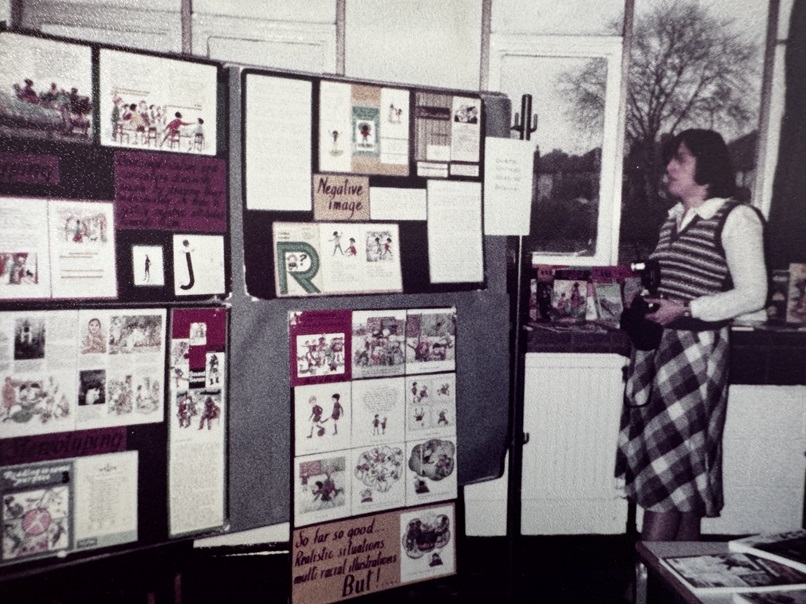


As an educational consultant, I continued to train, lecture, and write books and articles to support teaching a wider range of literature through the 1980s, 1990s and up to 2020. I co-wrote a best-selling book on teaching children with Special Educational Needs and Disability (SEND), and for 40 years I was a school governor and governor trainer, influencing sources of power in schools through practice, support, training and development.
A strong connection
I have always felt strong links and no small degree of gratitude to St Andrews for giving me the space to develop in what was a safe but exciting environment, and for looking after me in times of trauma and depression. I appreciated its small size and made dozens of friends in different circles. I remain in touch with very many of them. I spoke recently to Professor Emeritus Sam Taylor, now in his nineties and still brilliant. I regularly attend the London Alumni Carol Service at St Columba’s Church of Scotland on Pont Street.
I hope to return to St Andrews for the Kate Kennedy Club’s centenary celebrations and will be forever grateful for all that the University gave to me.