The Mountaineering Club, a 15,000km journey and saving the Scottish wildcat

Helen Senn (BSc 2005) is Head of Conservation and Science at the Royal Zoological Society of Scotland, where she is currently leading the reintroduction of wildcats into the Cairngorm National Park. Helen shares her memories of the Mountaineering Club at St Andrews, the 15,000km trip from Glasgow to China that inspired her book – Tea and Grit – and her work to recover species from the brink of extinction.
I was born in Ninewells Hospital, Dundee, and grew up in Ceres, close to St Andrews. When I was five, we moved to Switzerland (my father is Anglo-Swiss), so I basically chose to come back home for university. I suspect it was related to fond memories of building sandcastles on the East Sands, and the fact that I have never been much of a city person.
Bonds forged in the mountains
I made a beeline for the Mountaineering Club (STAUMC) during Freshers’ Week. Mountains are in both my Swiss and Scottish blood. The first meet was a trip to the Cairngorms, and it was so windy that I had to crawl on my hands and knees over the summit of Braeriach. I knew then that the Club was for me! In my first year we ventured to stunning locations such as the Ring of Steall, the Five Sisters and the Cuillin.
I also spent my first year in the Officer Training Corps (OTC). I am grateful for the insight into the military that basic training gave me. I very much enjoyed taking part in a military ski championship, but I am not really ‘soldier material’. I was constantly getting told off for my poor boot polishing and marching technique.
I spent many weekends out on the hills and in mountain huts. I think a theme of outdoor pursuits is that you really have to rely on each other and often live in close proximity in basic conditions. This tends to forge a strong bond, and I still get out into the hills with many former STAUMCers today.
I lived in Chattan (now McIntosh Hall) during my first year, then went back there to work as a dinner lady in my third and fourth years. It was a great job, as dishing up mounds of mash was a good way to switch off from studies, and we got fed for a pound! I was fortunate to live with some wonderful flatmates during my time at St Andrews. We had a freezing cold house in Greenside Court, furnished like a retirement home, but it was great, and we would make regular trips to Jannettas ice cream shop together.
I studied Environmental and Evolutionary Biology. I originally wanted to be a marine biologist, but reading The Blind Watchmaker by Richard Dawkins turned me on to evolutionary biology. I am really grateful for my experience at St Andrews. We were a small honours class and had great tutorials with Professor Jeff Graves, Professor Mike Ritchies, Professor Kevin Lala, Professor Emeritus Richard Abbott, Professor Tom Meagher and others. I remember laughing a lot during tutorials.
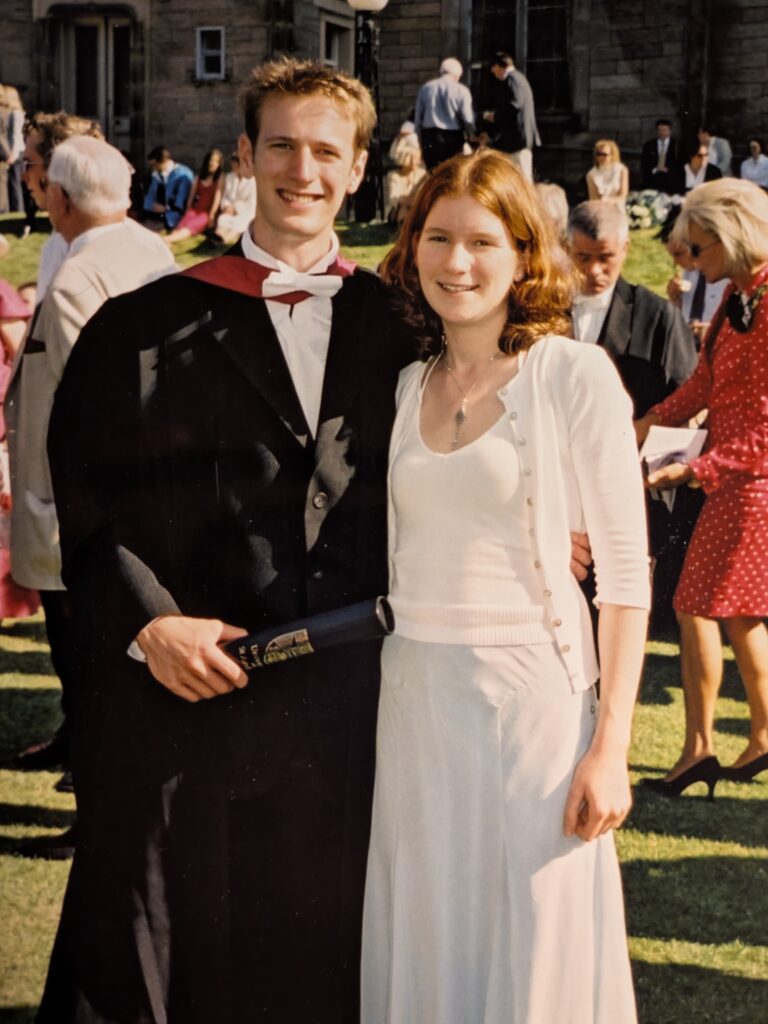
I met my husband, Ed Watson (BSc 2003), while climbing on the Maiden, a sea stack near St Andrews, alongside my friends Ewan Gorford (MA 2005) and Giles Oglesby-Wellings from the OTC. Giles tragically died in a climbing accident that summer, aged 19. There is a tree planted in his memory in St Salvator’s Quad, and I always stop by to say ‘hello’ when I am in St Andrews. Knowing that he did not get to do many of the things he wanted to has motivated me to make the most of my time on this amazing planet.
15,000 miles to China
Soon after completing my PhD in Evolutionary Genetics at the University of Edinburgh, Ed and I set off to cycle from Glasgow to China. We cycled 15,000km across Europe, Syria, Turkey, Iran and Central Asia. I was obviously keen on adventure, but I was also motivated by a desire to understand the world beyond the media portrayal of George W. Bush’s ‘axis of evil’.

I was living in Switzerland when the Berlin Wall came down and I guess I thought that was it – the ‘war’ was over, and things could only get better now. That moment in history seemed to be about breaking down barriers, but unfortunately, after 9/11, a lot of that seemed to get totally forgotten and walls started to go up again. I was fascinated by trying to understand how one country became another – perhaps I should have studied International Relations at St Andrews!

The trip was one of the best things I have done, but it was also incredibly sad to see how things have changed, especially in Syria and Iran. This led me to become involved with Citizens’ UK, where Ed and I helped bring the first family to Scotland through community refugee sponsorship.
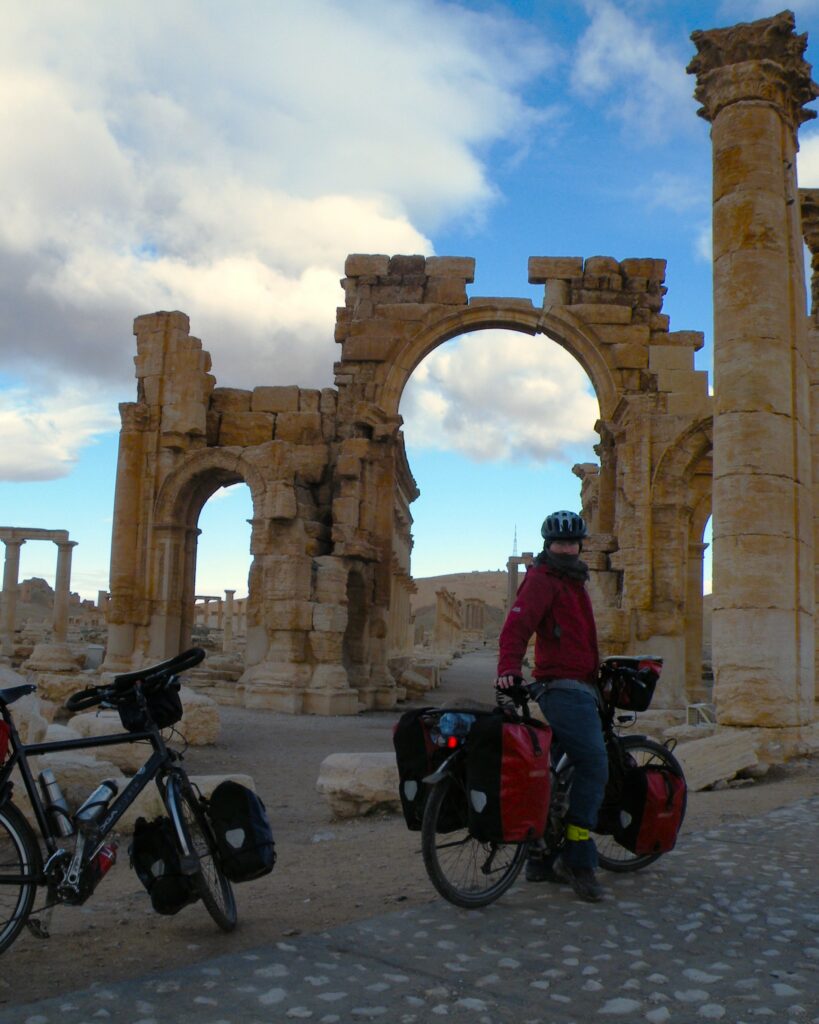
I published a book about the trip in January this year. It took me a while to write because so much had changed after we came back home. In a way, the book is about why it’s important to have face-to-face contact with people from other cultures and why a lack of that understanding has fed into some of our worst conflicts, which always stem from ‘othering’.

From the brink of extinction
I now work for the Royal Zoological Society of Scotland. I started as a lab technician shortly after we returned, fairly penniless, from travel. 15 years later, I am Head of Conservation and Science, a position I have held for the last eight years.
We are currently leading the reintroduction of wildcats and four native invertebrates in Scotland, and partnering on similar projects globally, such as the Siamese crocodile in Cambodia and the scimitar-horned oryx in Chad. My work involves collaborating with conservationists and academics from around the world.
I love the challenge of working to recover species from the brink of extinction. This process often involves gathering the best available knowledge and then taking an informed leap into the unknown. There is so much we don’t know, and not always enough time or, frankly, enough animals left, to conduct the necessary research to understand what will work best. I suppose you could say that it appeals to both my scientific brain and my sense of jeopardy.
It is a huge privilege to be part of a species’ journey to recovery, although it does take endurance. In some cases, it will be decades before we know whether what we are doing is working. It’s essential to plan projects with the intention of handing work on to the next generation, but for now, I’ve hopefully got a few more decades to go!
More information about Helen’s book, Tea and Grit: A Bicycle Journey along the Silk Road.