Saints Spotlight: Dr Niall Sreenan

Dr Niall Sreenan is a lecturer in the School of Modern Languages, which is ranked number one in Scotland and second in the UK in The Guardian University Guide 2026. In this month’s Saints Spotlight, he discusses the new Single Honours Comparative Literature programme and his recently published research into literary responses to Darwinism.
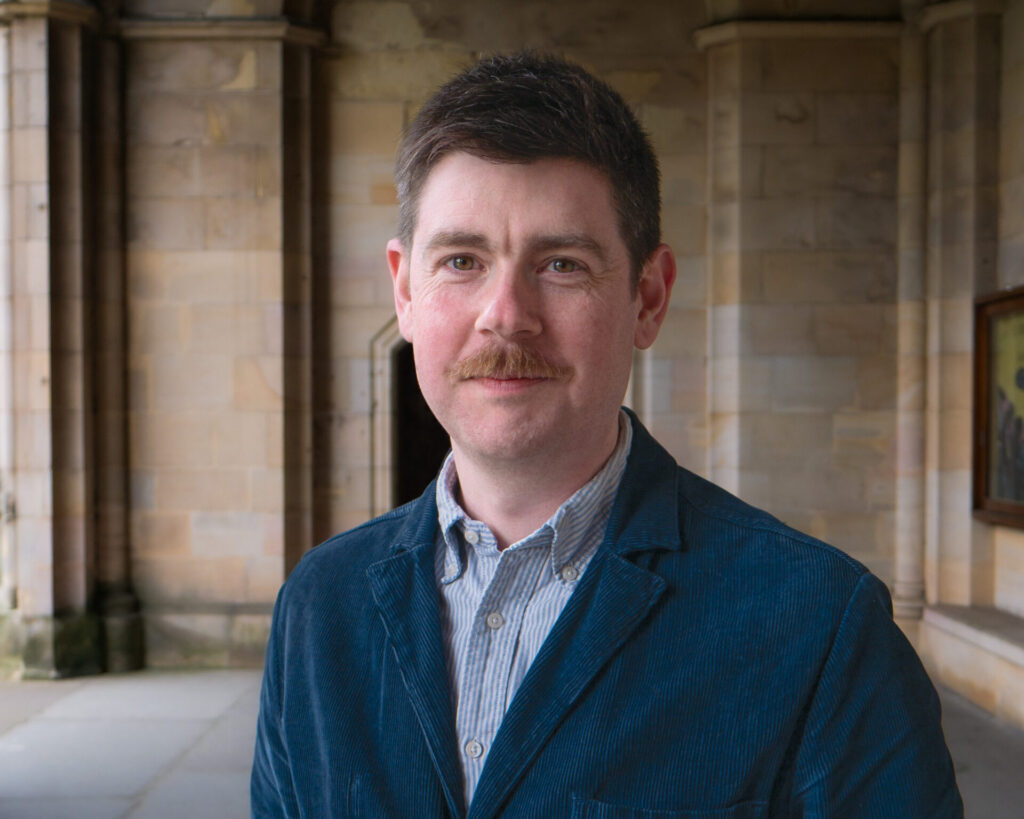
How did your St Andrews story start?
I came to St Andrews in 2023 as a Lecturer in Comparative Literature. Before that, I was a Research Associate at King’s College London’s Policy Institute. I worked on policy and impact-focused research, with a particular emphasis on education and the arts, having completed my PhD in Comparative Literature at University College London (UCL) a number of years earlier. So, after a decade working in London, it was quite a big change to come to St Andrews. And yet it was also like coming home, since I was returning to work in the discipline to which I had dedicated my PhD.
What are your current priorities at the University?
Comparative Literature at St Andrews is just 10 years old but is one of the best-regarded programmes of its kind in the UK. Last year, we launched a new Single Honours degree, which has already started to attract new students to study literature in the uniquely cross-cultural and interdisciplinary way that characterises our field. These successes are largely down to the stellar work of colleagues who have helped develop Comparative Literature at St Andrews, so my aim as a relatively new arrival is to try to sustain the high quality of our teaching, while also expanding and diversifying our curricula to accommodate greater numbers of students.
Research-wise, I recently published a monograph on the literary reception of Darwinism in 19th-century realism and utopian literature. So now my priority is to develop an entirely new project on literary and cultural representations of adopted children and the phenomenon of what legal scholars and anthropologists call ‘fictive’ kinship. I’m working on a number of pieces on this subject – both academic and for wider public audiences – which I hope will see the light of day in the coming year, so keep an eye out!
What is the focus of your research at St Andrews?
My research interests are diverse and varied. They include, among other things, the relationship between Darwinism, 19th-century literary realism and utopian writing (the subject of my recently published book, Rethinking the Human in the Darwinian Novel), islands in literature and philosophy, and psychoanalysis. My most recent research focuses on literary and mythic representations of child adoption, as well as the wider philosophical and social questions raised by the notion of so-called ‘non-consanguineous’ (not biological or genetic) forms of family relations.
I would say, however, that these subjects are connected by a set of broader questions about the way in which literary writing responds to apparently intractable social, scientific, or philosophical issues. How does literature allow us to think through our understanding of ourselves as simultaneously human and animal? Or about the possibility of revolutionary political or social change? I am interested not only in what kinds of texts or artworks allow us to think through these issues, but also in what kinds of reading nurture this type of thought.
Tell us about your proudest achievement.
The publication of my recent book felt like a big achievement. This was the subject of my PhD, so it represented a culmination of a years-long process of intellectual and personal labour that spanned the Covid-19 pandemic, the arrival of two kids, several house moves, changes in job, and then ultimately the move to St Andrews. So, I’m proud of the book itself, as well as the achievement of managing to publish it!
Where is your favourite spot in St Andrews?
I love going for walks and picnics with my kids in the St Andrews Botanic Garden. It’s like a peaceful garden utopia. It’s an amazing place to watch the seasons change, and I always leave there with a renewed sense of calm. It is also an important place for its innovative research projects on climate change and biodiversity, and there are often great talks and events.