From shortage to simulation

How AI at St Andrews is supporting the next generation of doctors
Scotland is renowned for producing clinically adept, pioneering medics, and the University of St Andrews has a key role to play. The School of Medicine ranks consistently highly (4th in the UK, Guardian University Guide 2026) and in September 2025, the University celebrated the return of a full medical degree and clinical medical school.
Scotland is also facing a stark reality: there simply aren’t enough doctors to meet the growing demand for healthcare. Training medics is a complex process and the push to increase numbers raises questions of capacity, access to quality teaching, and the need to ensure learning opportunities are sufficient for the next generation of doctors to be equipped with the skills they need for success.
“As medical educators, we know how many medical students there are in the UK, and we know that these numbers may increase,” says Dr Andrew O’Malley, a Senior Lecturer in the School of Medicine, specialising in generative AI, medical education and digital assessment. “We also know what the pinch points will be – and that they will be faced by every medical school. Placement capacity and roleplay actors remain static.”
Direct interaction with patient volunteers is essential for medical students to develop the communication and consultation skills that underpin safe, empathetic, and effective clinical practice.
To address this challenge, Dr O’Malley and colleagues have developed a patient simulator, built from scratch by AI Applications Designer Sayed Murad using the team’s research and vision.
It’s an AI-powered platform that allows students to rehearse full consultations in three formats: audio, visual and written. After each session, students receive structured feedback on five domains of communication from opening the consultation to closing it, mapped to the Calgary Cambridge framework and the UK Medical Licensing Assessment.
Underpinning this is SimPatient’s patient generator, which contains a diversity engine to ensure that patients appropriately represent groups that are often underrepresented in medical training. They vary by age, ethnicity, accent, literacy level, and socioeconomic context. Recordings of the University’s own medical students in learning consultations are being used to train the AI model.
“This not only improves representation, but strengthens students’ ability to practise culturally competent care,” says Dr O’Malley.
In a demonstration, we meet ‘Cameron’, an elderly gentleman from a rural area of Scotland. He speaks with a thick, Scottish accent and doesn’t want to trouble the doctor. He’s been having heart ‘flutters’ for a few months. The consultation plays out, with Cameron responding intuitively to the doctor’s line of questioning as they take a medical history and work towards a possible diagnosis. It’s much as you’d expect from a real visit to your local GP.
“St Andrews is the only university in Scotland with a programme dedicated to encouraging graduate careers in remote and rural medicine, which is so important,” Dr O’Malley explains. “We’re seen as world leaders in developing medical education in really distributed rural settings, and this is something we have considered when developing SimPatient. This work is unique to St Andrews.”
He’s referring to the Scottish Graduate Entry Medicine (ScotGEM) MBChB at the University, which has been tailored to meet the current and future needs of the NHS in Scotland and focuses on rural medicine and healthcare improvement.
According to Dr Sandhya Duggal, Lecturer in Medical Sociology and Communication Skills at St Andrews and a member of the SimPatient team, the platform isn’t a replacement for real-life interactions. “We always have a preference for real human beings because that’s who our doctors are going to be treating,” she says. “But if those people are not available to train the number of doctors needed, our simulated patients can support the learning process.
“We have patient actors who interact with our students and that’s great, but we do have missing characteristics in terms of diversity. Having spoken with colleagues in other medical schools, the situation is the same across the board. The development of SimPatient has come at a really opportune moment, and it has absolutely widened our students’ abilities to think about and respond to cultural differences.”
Dr Duggal also raises the question of some students experiencing social anxiety around in-person interaction, especially in the earlier years of their degrees.
“I do think there is a generational difference we are seeing now in terms of communication,” she says. “The younger generations are often more hesitant about picking up the phone or engaging in eye contact.
“From that perspective, SimPatient is an inclusion tool. It gives students something to use at home, on their laptop, to practise, where they know nothing can go wrong. Having this tool encourages them to build their confidence levels, and that’s where I see the platform as being really beneficial in the future.”
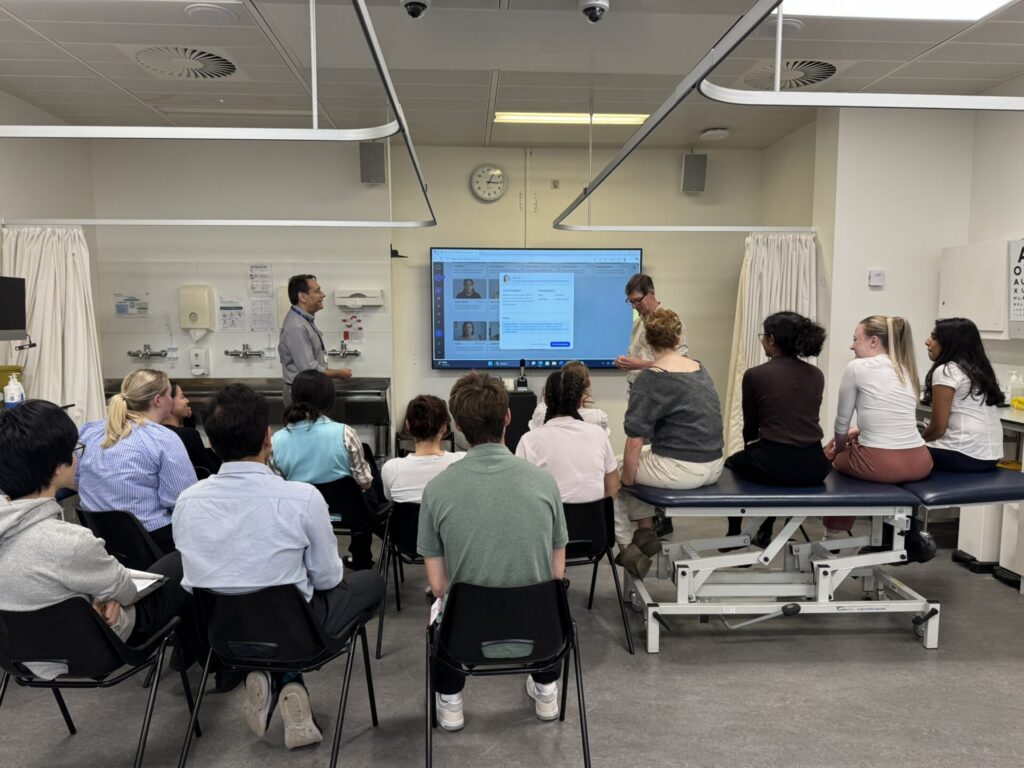
Around 700 students at St Andrews are using SimPatient, and it’s being piloted at around a dozen institutions in the UK, Ireland, Switzerland, the US and the Middle East.
The next stage is to develop the commercial side of the project, for which Dr O’Malley and his team have been working with St Andrews Innovation. And what started as a research and education-led solution to a problem has already gained national recognition: in October 2025, SimPatient won the Kickstart Entrepreneurial Spirit Award at the 2025 Converge Awards, presented by Scotland’s Deputy First Minister, Kate Forbes. The project was also included in OpenAI’s Global Faculty AI Project, further underscoring its international relevance.

“The Converge award recognised not only the innovation behind SimPatient, but also the growing importance of AI in shaping the future of healthcare education,” says Dr O’Malley. “We’re excited about the potential this technology from the University of St Andrews has to support learners and institutions on a global scale.”
The Digital Nexus building at St Andrews will create a cutting-edge interdisciplinary hub for the sciences, enabling further research into AI, early diagnosis, sustainable computing and more. Designed to foster collaboration between the Schools of Computer Science, Medicine and other disciplines, it will create an intellectual powerhouse that will educate, inspire and discover solutions – and change lives for the better. Find out more.
This article first appeared in Chronicle 2026. For additional content, including news, stories and videos, visit Chronicle Extra, the digital companion to the magazine.